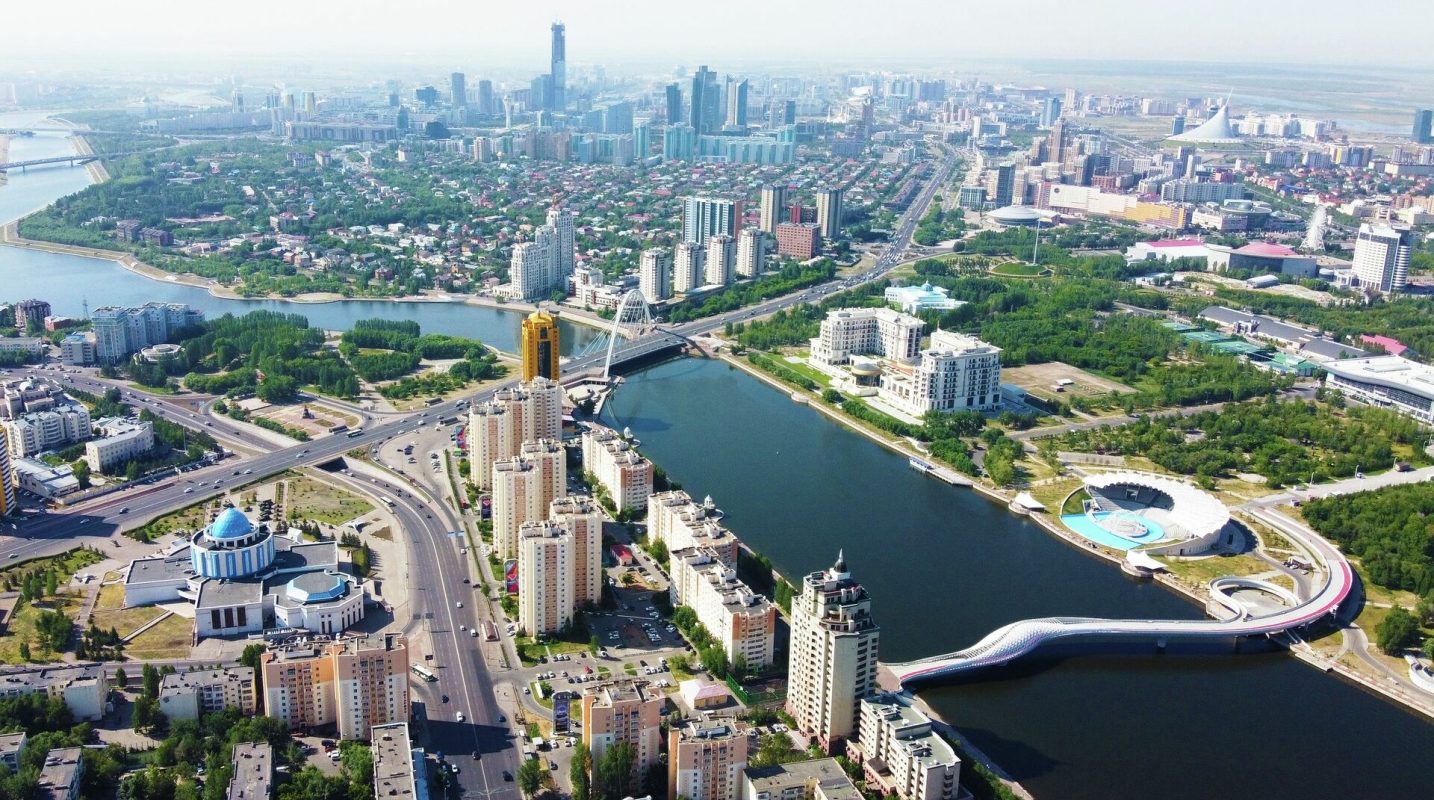
Astana became the capital of Kazakhstan in 1997, and almost everything a visitor comes to see was built after that date. The left bank of the Ishim River is a showcase of Norman Foster pyramids and tents, a golden tower from a Kazakh legend and the largest mosque in Central Asia. The right bank is the old Soviet town of Tselinograd with its apartment blocks and a quieter pace. Both are worth a day. Below are the nine places that define the city, with the facts, prices and small details that help plan a visit.
Hazret Sultan Mosque
Hazret Sultan Mosque opened in 2012 on the left bank next to the Palace of Peace, and until 2022 it was the biggest mosque in Central Asia. It holds about 10,000 worshippers under a 51-metre main dome, with four minarets rising to 77 metres. Its name means “Holy Sultan” and refers to Khoja Ahmed Yasawi, the 12th-century Sufi poet whose mausoleum in Turkestan is the country’s main pilgrimage site. Inside, the white marble and the carved Kazakh ornament on the walls are the point, and the scale takes a minute to register. Entry is free. Women need a headscarf, and nobody in shorts gets past the door.
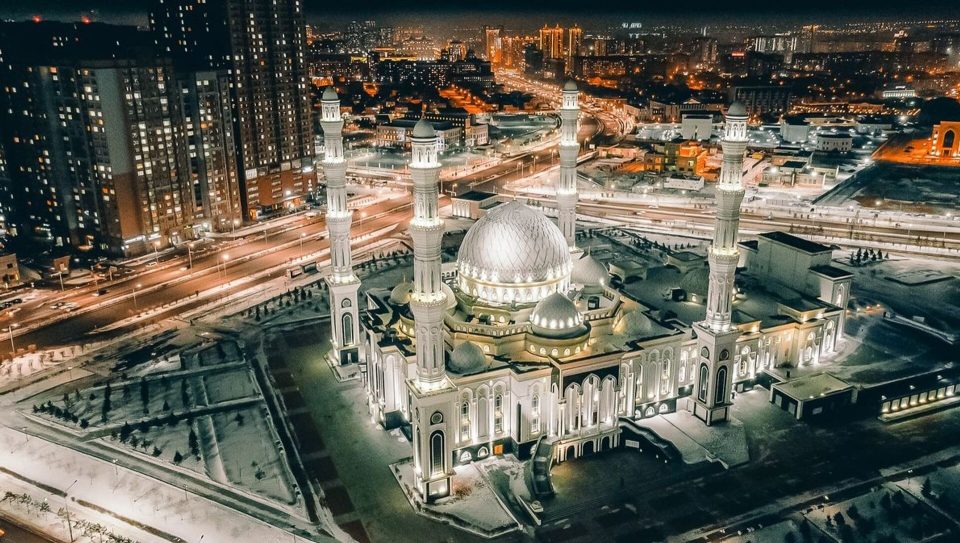
Its designers borrowed from the classic Ottoman mosques, Istanbul’s Blue Mosque in particular, which is why the silhouette looks familiar to anyone who has been to Turkey. Since 2022 the title of largest mosque has passed to the Astana Grand Mosque across town, a vast white complex with 130-metre minarets and room for 30,000 inside. Seeing both in one afternoon shows how fast the city’s ambitions have grown.
Palace of Peace and Reconciliation
Across the square from the mosque stands a 62-metre glass pyramid. Norman Foster designed it for the 2006 Congress of Leaders of World and Traditional Religions, and the building was finished in record time to host it. Steel and glass were chosen to stand for openness between faiths, and the geometry works: the pyramid reads from most of the left bank.
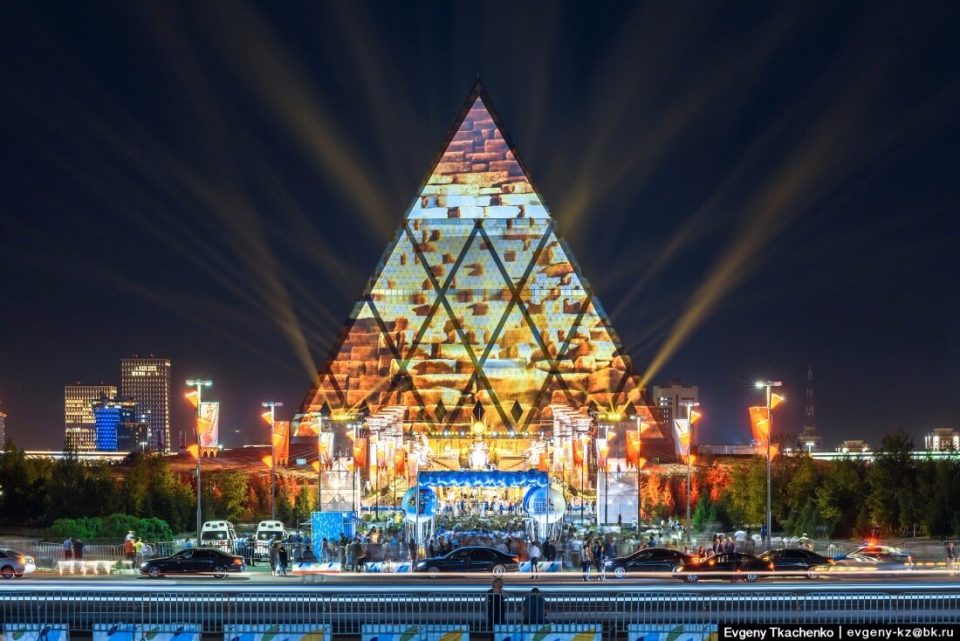
Inside, a 1,300-seat opera hall fills the base. Above it is a museum of Kazakhstan’s ethnic groups. At the apex sits a round conference hall under stained glass by Brian Clarke, with 130 doves painted on it. Visits are by guided tour only, which run through the day in Kazakh, Russian and English and cost a few thousand tenge. Each level has its own colour scheme to mark the different faiths and cultures of the country. Between congresses the building hosts concerts and business forums. A private half-day city tour usually pairs it with the mosque and Baiterek, which saves working out the bus routes between them.
Library of the First President of Kazakhstan
Despite the name, this is a museum rather than a library. Foster designed it too. It looks like a flying saucer landed on the boulevard, opened in 2014, and covers the life and career of Nursultan Nazarbayev, who ran the country from 1990 to 2019.
Its collection runs to documents, photographs, state gifts from foreign leaders and a large archive of books and art. Whatever one thinks of the cult around the first president, the building explains how modern Kazakhstan sees its own founding story, and it is the best single stop for understanding the symbolism on every other monument in town. Exhibits lean on screens and multimedia, so an hour is enough.
Baiterek Tower
Baiterek is the symbol of the city, printed on banknotes and fridge magnets. Built in 2002, it stands 105 metres tall with a golden sphere on top. The shape illustrates a Kazakh legend. The bird Samruk laid its egg in the crown of the tree of life, the Baiterek, and the egg is the sun. A cafe and souvenir shops sit at the base, but the reason to come is the observation deck inside the sphere at 97 metres.
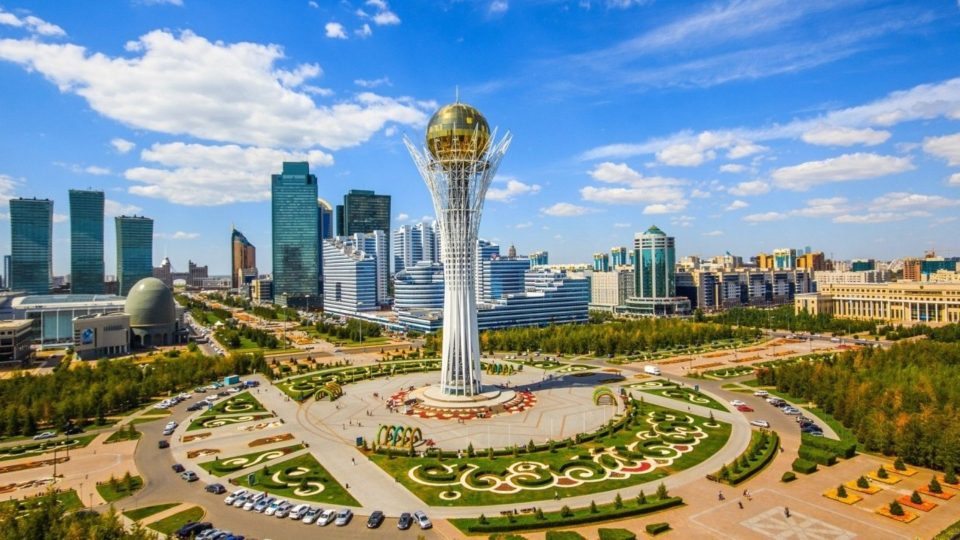
A lift takes about a minute to reach the sphere. In the centre of the deck is a gilded cast of Nazarbayev’s right hand; locals and tourists alike put their palm into it and make a wish, and the queue for that is often longer than the queue for the lift. From the windows the whole Nurzhol axis lines up: the presidential palace at one end, Khan Shatyr at the other. The word “baiterek” means tall poplar in Kazakh. Come at dusk. The boulevard fountains and the building lights switch on, and the view after dark is the better one.
Khan Shatyr Entertainment Center
Khan Shatyr is a 150-metre transparent tent at the west end of the boulevard, the third Norman Foster building in this list and the one people photograph most. It opened in 2010. In plain terms it is a shopping mall. The shape is a giant yurt.
Inside are shops, a food court, cinemas and, on the top level, a water park with an indoor beach whose sand was shipped from the Maldives. In January the street outside sits at minus 30. Swimming under the tent in 30-degree air at that moment is strange and pleasant, and it explains why the place is full of families all winter.
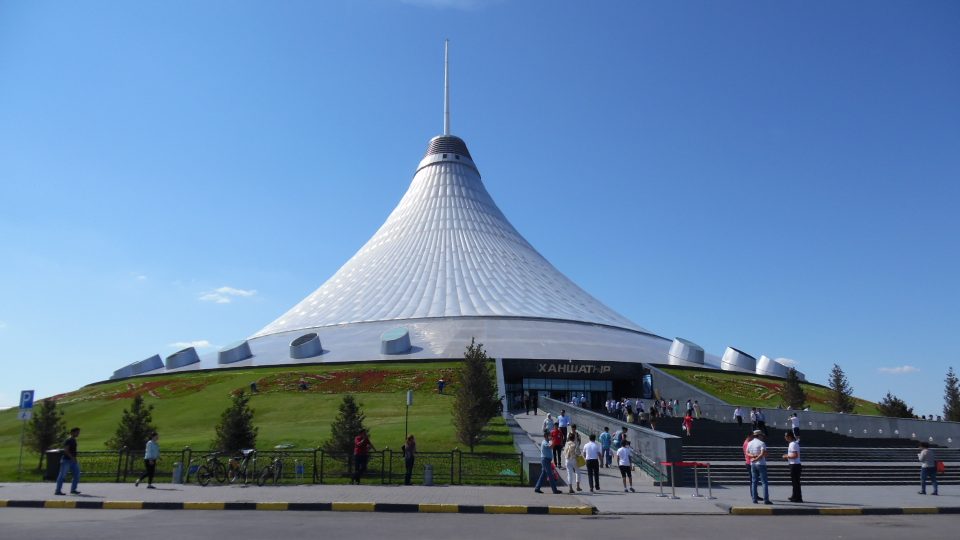
The roof is a membrane of ETFE, the same plastic used on the Beijing Water Cube, which lets sunlight through and holds heat. That is how the tent keeps a comfortable temperature across a climate that swings from minus 40 to plus 35 over the year.
Museum of Future Energy
Nur Alem, the Museum of Future Energy, was Kazakhstan’s national pavilion at EXPO 2017 and is the largest spherical building in the world, 80 metres across. The theme of that EXPO was future energy, and the eight floors inside follow it: solar, wind, biomass, water and the energy of space, each on its own level.
Exhibits are hands-on. Visitors generate power by pedalling, watch algae being turned into fuel and compare solar panel designs, and the top floor has a glass walkway over the void with a view of the whole EXPO site. It is the one museum in the city where children do not need persuading. Allow two hours, and check the ticket desk for the English audio guide.
The sphere sits in the former EXPO grounds in the south of the city, which have since become a business and university district. Astana Hub, the main tech incubator in Central Asia, works out of the old pavilions next door.
Nurzhol Boulevard
Nurzhol Boulevard is the pedestrian spine of the new city, laid out by Japanese architect Kisho Kurokawa, who wrote the master plan for the whole left bank. It runs for about two kilometres from the presidential palace Ak Orda, past Baiterek, to Khan Shatyr, with fountains, lawns, sculptures and the ministries lined up on either side.
Walking its full length is the simplest orientation to Astana, because every major landmark either stands on it or is visible from it. Summer evenings are the time: the fountains run, the lights come on, and half the city is out strolling. A private night tour of the illuminated city covers the boulevard by car with stops for photographs, useful in winter when two kilometres on foot at minus 25 is a serious undertaking.
The boulevard was conceived as a symbol of the new Kazakhstan. Kazakh ornament is worked into modern forms along its whole length, from the lamp posts to the paving.
Nur-Astana Mosque
Nur-Astana was the city’s main mosque from 2005 until Hazret Sultan opened. Lebanese architect Charles Hafiz designed it, and the money came from Qatar as a gift between the two states. White walls, a 40-metre golden dome and four 63-metre minarets give it a lighter, more classical look than its bigger successors, and it holds about 5,000 worshippers.
Prayers run daily. Visitors are welcome between them under the same dress rules as elsewhere. It stands on the left bank near the Ishim embankment, a short walk from the Astana Opera, which makes a good pairing for an afternoon.
Across the river, the old right bank has its own, smaller sights. There are the Soviet-era streets of Tselinograd, a few wooden merchant houses from the Russian Empire period and the central market. A tour of the old city’s imperial and Soviet architecture is the way to see that half, since none of it is on the standard route.
National Museum of the Republic of Kazakhstan
Opened in 2014 on Independence Square, this is the biggest museum in the country. It covers 74,000 square metres. Its halls run from the Bronze Age steppe to the space programme at Baikonur.
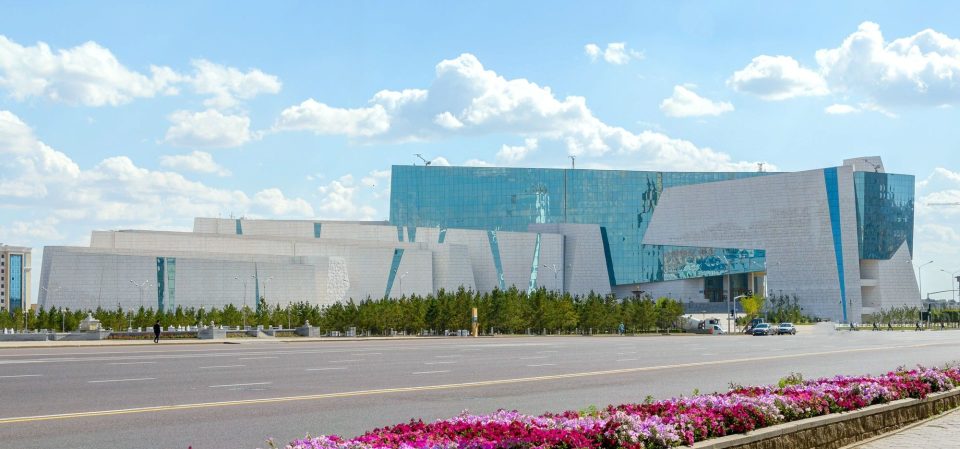
Start in the Hall of Gold on the ground floor. Its centrepiece is the Golden Man. Saka nomads buried this warrior near Issyk in the 5th century BC in a suit of 4,000 gold plates, and the gold bowl found in the same kurgan sits beside him. The nomad halls upstairs explain yurts, horse gear and clan structure better than any guidebook. Touchscreens and holograms carry the modern sections. Two hours covers the highlights, and a full morning is not wasted.
For the darker side of the 20th century, the camps of the Gulag system around Karaganda and the ALZHIR memorial for wives of “enemies of the people” outside the city are open to visitors. A day trip to the Karaganda labour camp museum covers the KarLag headquarters in Dolinka and the regional capital, about three hours each way by road.
Where to Stay and Where to Go Next
The practical choice is the left bank, within walking distance of the boulevard, because the sights are there and taxis in winter are not always quick to come. Grand Park Esil is a mid-range hotel on the right bank by the river, a 20-minute walk across the bridge to Baiterek, and a fair compromise if left-bank prices are high. Mid-week rates are lower than at weekends, and July, when the city holds its Capital Day holiday, is the most expensive week.
Astana is also a base. Burabai National Park, with its pine forests, granite outcrops and lakes, lies 250 kilometres north and is the standard escape from the steppe. A day tour to Burabai runs about twelve hours door to door and includes the lakeside walk at Borovoe and the Okzhetpes rock. Trains and shared taxis do the same route for anyone staying overnight.
Timing matters more here than in most capitals. Astana is the second-coldest capital in the world after Ulaanbaatar, with winter lows below minus 30 and a wind that makes it feel colder. June to September is the window for walking the boulevard in comfort. The first week of July, around Capital Day, brings fireworks, concerts and the biggest crowds of the year.


