Samarkand has been a city for at least 2,750 years, and almost everything a visitor photographs was built in a single century, between 1370 and 1470, by Timur and his grandson Ulugbek. Everything from the 2,000 years before is underground on the Afrasiab hill, and the 500 years after are in the Russian town west of the Registan. Reading the city’s history in the right order turns a checklist of blue domes into something you can follow with your feet. I lived in Uzbekistan for several months, and Samarkand is the city I would send a first-time visitor to before any other. This is the timeline as the monuments tell it, with 2026 ticket prices in Uzbek sum.
Afrasiab and the Sogdian City
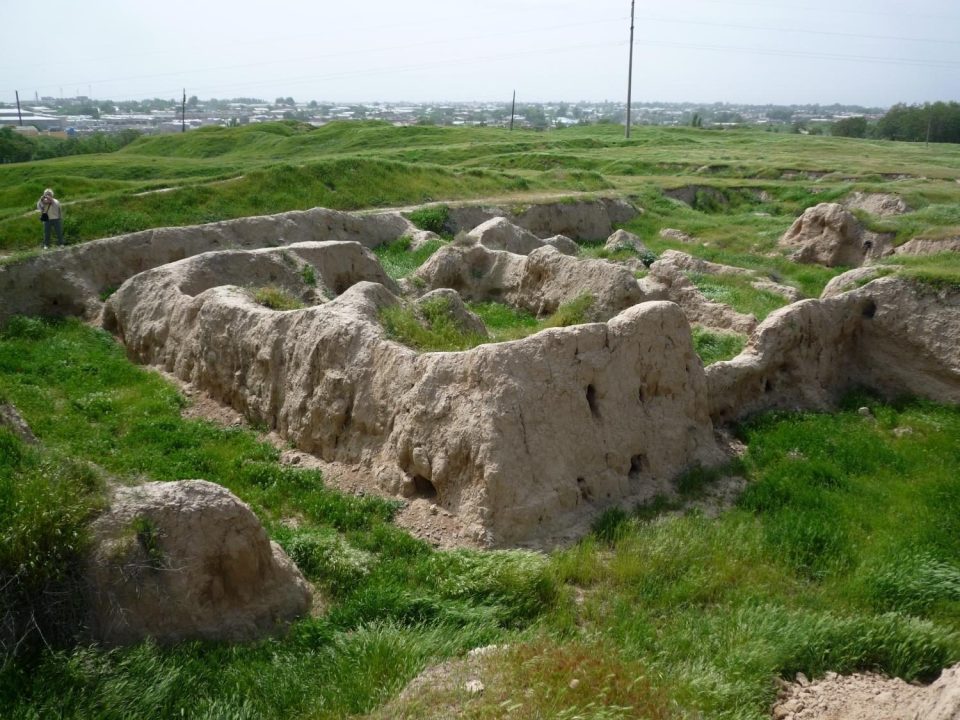
A bare hill northeast of the Bibi-Khanym mosque is the original Samarkand. Archaeologists date the first walls on Afrasiab to the 8th or 7th century BC, when the city was Marakanda, capital of Sogdiana, a Persian satrapy of traders and farmers. Alexander the Great took it in 329 BC and, according to the Greek historians, murdered his general Cleitus here in a drunken argument in 328. Under the Sogdians the city grew into the main relay station between China and Persia; Sogdian merchants ran the Silk Road trade for 500 years and their language was the lingua franca from Xi’an to Merv.
Arab armies took Samarkand in 712, and it became one of the great cities of the Islamic world under the Samanids in the 9th and 10th centuries, a center for paper making, which the Arabs learned from Chinese prisoners after the battle of Talas in 751 and passed on to Europe from here. Then in 1220 Genghis Khan arrived. His army breached the walls, killed or enslaved most of the population, and destroyed the irrigation canals. Afrasiab was abandoned and never rebuilt. What grew back grew to the south, on the site of today’s old town.
On the edge of the site, the Afrasiab Museum holds the finest thing to survive from Sogdian Samarkand: a 7th-century wall painting from a palace, showing an embassy with gifts, a royal hunt and a Chinese princess in a boat, in colors still bright. It is one of the most important early paintings in Central Asia and most visitors skip it. Open 9:00 to 18:00, entry about 40,000 sum, a 15-minute walk north of Bibi-Khanym past the Hazrat Khizr mosque.
Timur Builds a Capital
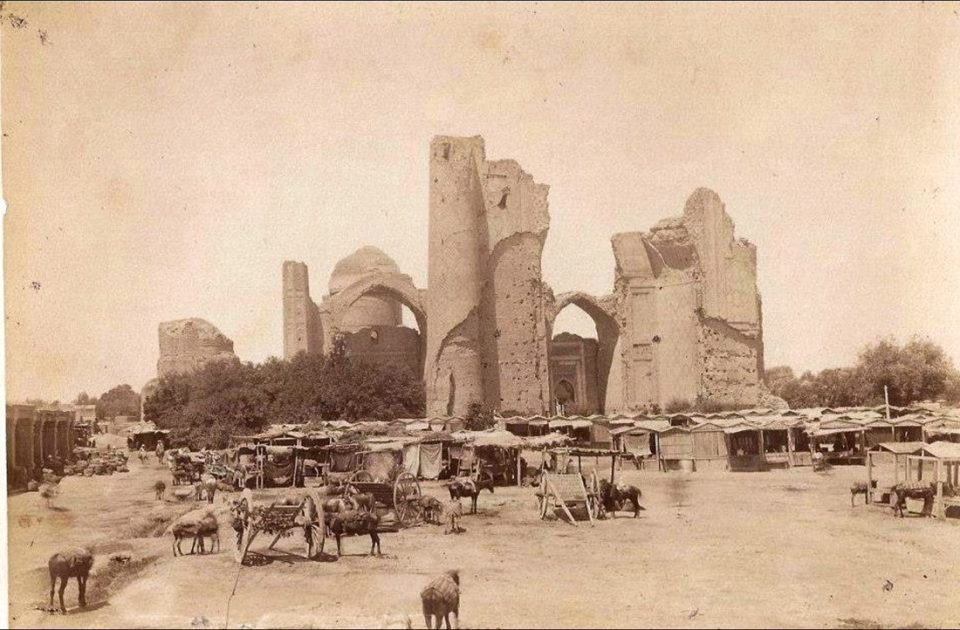
Timur, known in the West as Tamerlane, made Samarkand his capital in 1370 and spent the next 35 years conquering from Delhi to Ankara and sending the loot and the craftsmen home. He built few things himself but he built them large. Bibi-Khanym mosque, started in 1399 with the spoils of India, had a portal 35 meters high and a main dome that contemporaries compared to the sky. It was too large for its own engineering; bricks were falling on worshippers within a few years, and by the 19th century it was a ruin used as a cotton market. Soviet restorers rebuilt the domes from 1974 onward, so what you see is a modern shell over Timurid foundations. The scale is real, and the marble Koran stand in the courtyard is original.
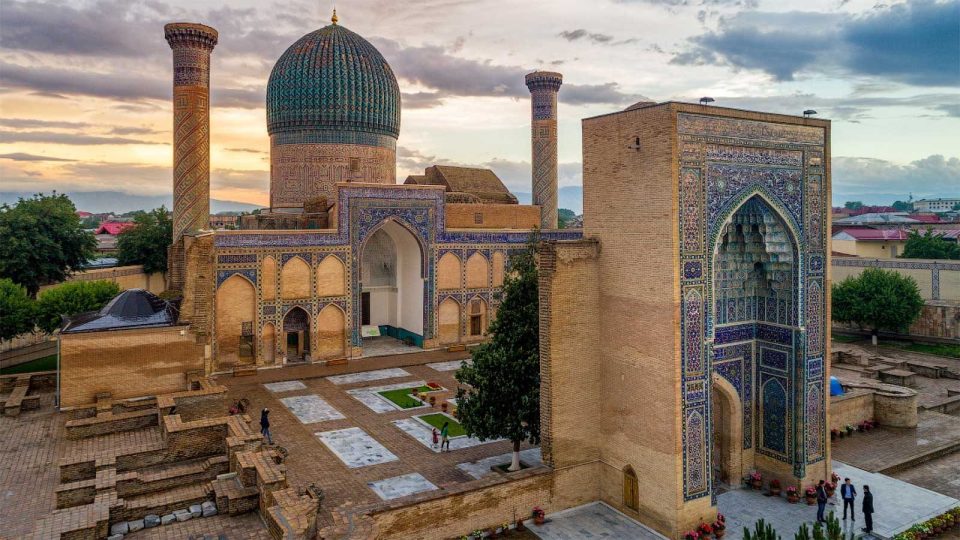
Timur’s tomb is the Gur-e-Amir, built in 1404 for his favorite grandson and used for Timur himself when he died on campaign in 1405. Its fluted turquoise dome and gold-painted interior became the model for the Taj Mahal two centuries later. A dark green jade slab in the center marks his grave; the bodies are in a crypt below. Soviet anthropologists opened the tomb on 21 June 1941 and confirmed the emperor’s lameness from the skeleton. Germany invaded the Soviet Union the next day, which is the kind of coincidence Samarkand guides do not let pass. Entry about 50,000 sum, open 8:00 to 20:00 in summer, and best seen lit at night.
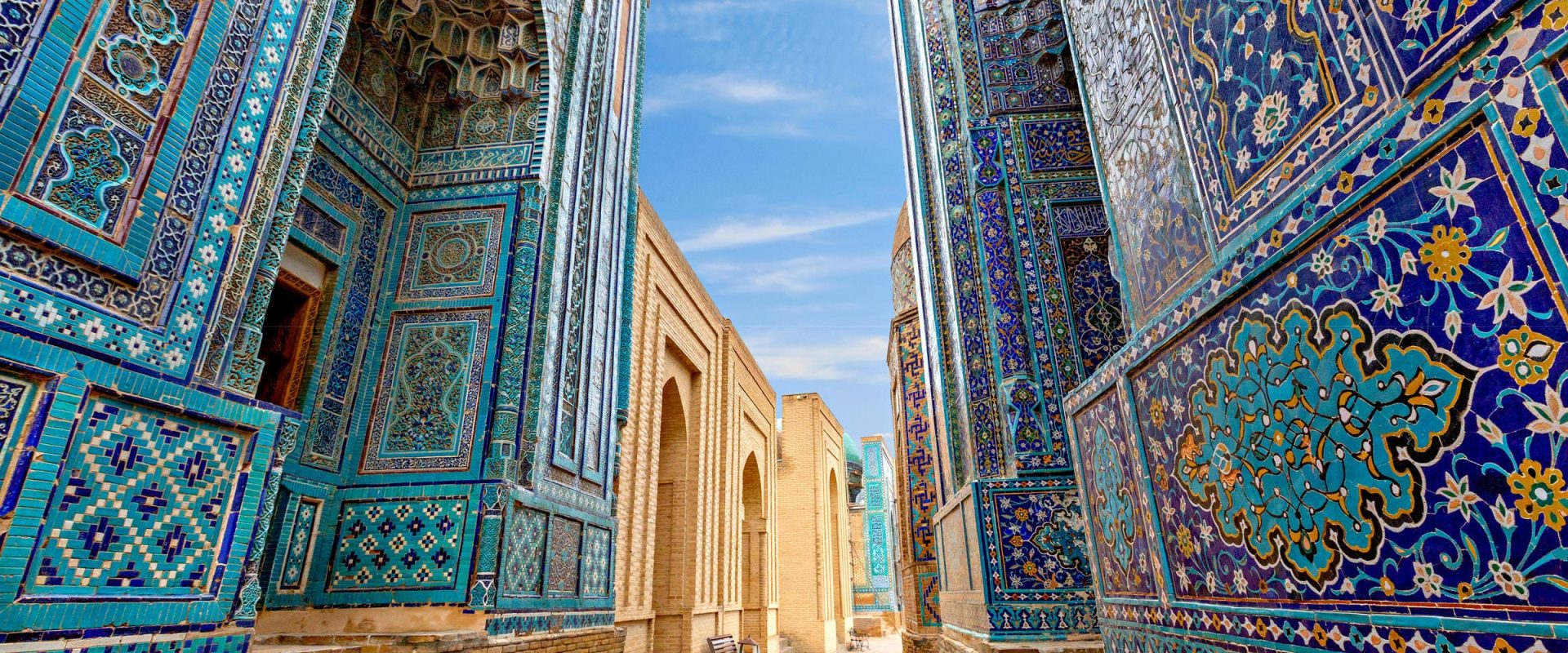
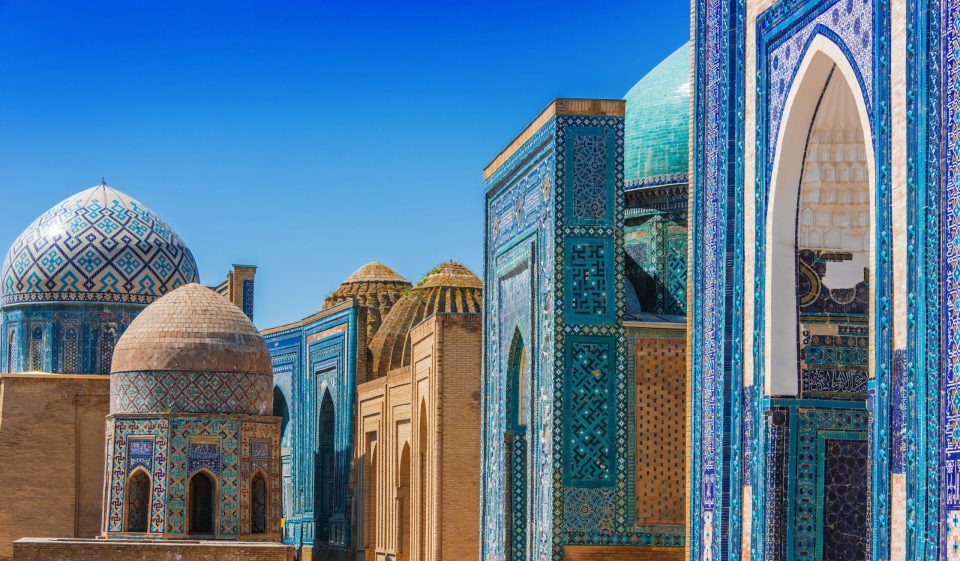
Shah-i-Zinda, the avenue of tombs on the slope of Afrasiab, is where the Timurid tilework is at its most delicate. Twenty mausoleums line a narrow lane climbing to the shrine of Kusam ibn Abbas, a cousin of the Prophet said to have brought Islam to the city in the 7th century. Most of the tombs are for Timur’s female relatives and generals, built between 1370 and 1405, and the carved and glazed terracotta on the Shadi Mulk Aka mausoleum of 1372 is generally considered the finest surface in Samarkand. Entry about 40,000 sum, open dawn to dusk; go before 9:00 to have the lane to yourself.
Ulugbek and the Registan
Timur’s grandson Ulugbek ruled Samarkand from 1409 to 1449 and cared more about mathematics than conquest. His madrasah on the west side of the Registan, built between 1417 and 1420, was a university where he taught astronomy himself, and the star-patterned tiles on its portal are an astronomer’s signature. On a hill three kilometers northeast he built a three-storey observatory housing a sextant with a radius of 40 meters, cut into the rock. With it he measured the length of the year to within a minute of the modern value and catalogued 1,018 stars. His son had him murdered in 1449 and religious conservatives razed the observatory; the underground arc of the sextant was rediscovered in 1908 and is what you visit today, with a small museum. Entry about 40,000 sum, a 15,000-sum taxi from the center.
Two more madrasahs came 200 years later, under the Uzbek Shaybanid and Ashtarkhanid dynasties who ruled from Bukhara. Sher-Dor, on the east side, was built between 1619 and 1636 as a mirror image of Ulugbek’s, and its portal carries the tigers chasing deer under a human-faced sun that appear on Uzbekistan’s banknotes, a rare breach of the Islamic ban on living figures. Tilya-Kori, closing the north side, was finished in 1660 and doubled as the city’s Friday mosque; its interior is covered in gold leaf, restored in the 1970s, and is the reason for its name, which means gilded. The square between them was the market and execution ground of medieval Samarkand.
One ticket of about 65,000 sum covers all three madrasahs and is valid for the day. The square is open from 8:00 until about 23:00, with a light and sound show most evenings in season at around 20:00 or 21:00 that is included in the ticket. Come twice: in the morning for the tilework and after dark for the square itself. A guided tour of the Registan and Timurid sites runs about three hours and is the most efficient way to keep the dynasties straight.
Decline, Russia and the Railway
After the capital moved to Bukhara in the 16th century, Samarkand shrank. Sea routes replaced the Silk Road, the Zerafshan irrigation system decayed, and for several decades in the 1720s the city was reported almost empty. The monuments survived because nobody had the money to replace them, and earthquakes did the damage that neglect did not; the leaning minarets of the Registan were straightened by Soviet engineers in the 1920s and 1960s.
Russian troops took the city in May 1868 after a battle at the Zerafshan crossing, and in 1888 the Trans-Caspian railway arrived, turning Samarkand into a cotton town. Russian planners built a new European quarter west of the old city, with a grid of streets radiating from a park, and it is still the administrative and university district. University Boulevard, with its plane trees and tsarist-era buildings, is a pleasant half hour that shows the other Samarkand. From 1925 to 1930 the city was the capital of the Uzbek SSR before Tashkent took over.
Samarkand Since Independence
UNESCO listed the historic city in 2001, and the government has spent the years since restoring and, critics say, over-restoring the monuments. That program produced the pedestrian avenue from the Registan to Bibi-Khanym, and also the wall that screens the old mahalla neighborhoods from tourist eyes; walk through the gaps in it to see how people live between the monuments. Afrosiyob high-speed trains, launched in 2011, brought Tashkent within 2 hours 10 minutes and turned Samarkand into a day trip, which changed the city more than anything since the railway. A seat costs about 200,000 to 300,000 sum depending on class.
Siyob bazaar next to Bibi-Khanym is where the timeline closes. Traders have worked on or near this spot since the city was rebuilt after the Mongols, and the round Samarkand bread stamped with patterns is baked the same way travelers described it 500 years ago. A loaf costs about 8,000 sum. Buy one, sit on the mosque steps, and you have done what visitors to this city have done since Timur.
Following the Timeline on Foot
- Morning. Afrasiab Museum for the Sogdian murals, then Shah-i-Zinda while the light is low and the lane is empty. About two and a half hours.
- Midday. Bibi-Khanym and Siyob bazaar for lunch. One and a half hours.
- Afternoon. The Registan with the combined ticket, then a taxi to Ulugbek’s observatory. Three hours.
- Evening. Gur-e-Amir at dusk, then back to the Registan for the light show.
Total ticket spend for the day is about 235,000 sum, under 20 US dollars. For the sights this history skips, our list of the seven essential Samarkand sights adds Khazrat Khizr and the Konigil paper mill. Getting here by train or air is covered in Samarkand travel tips, and the hotel guide explains why staying within a ten-minute walk of the Registan pays for itself in taxi fares.


