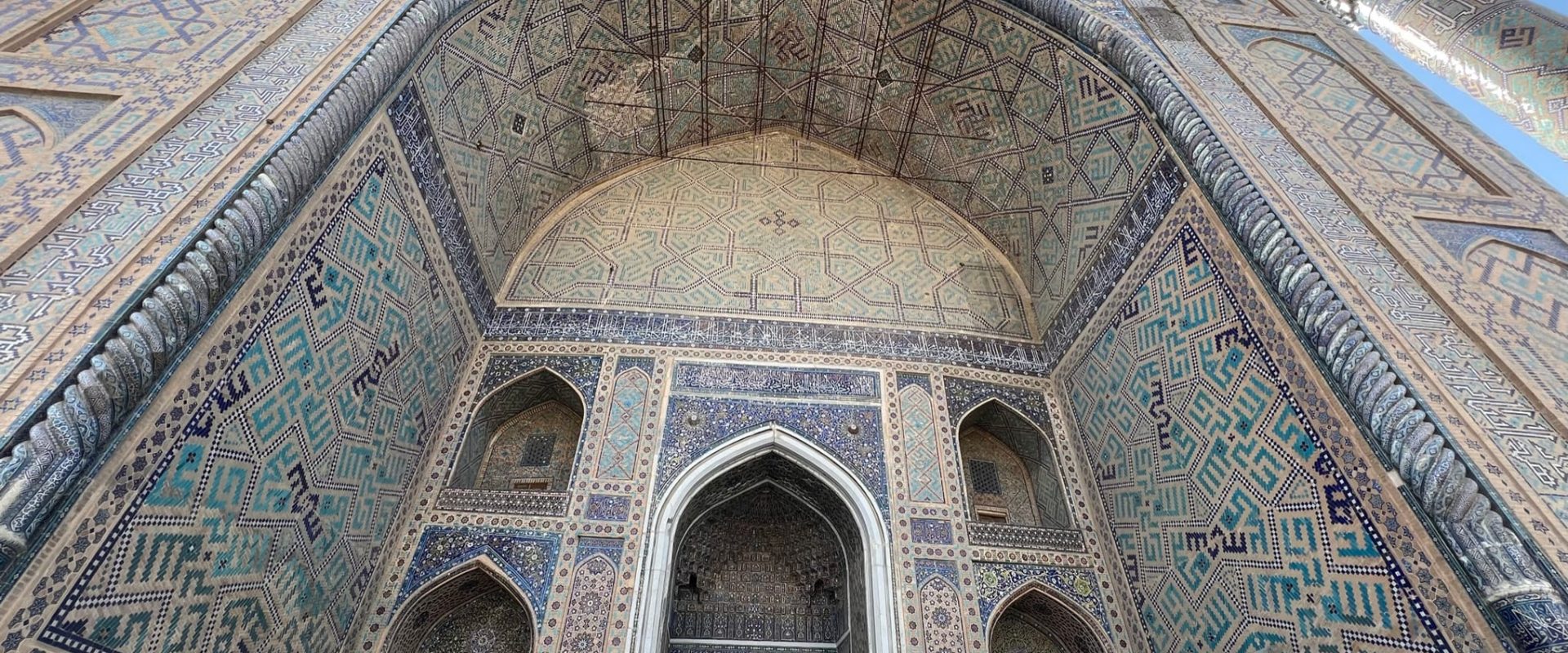
Samarkand feels ancient because it is. Settlement on this spot goes back more than 2,500 years, and the city has outlived Alexander, Genghis Khan and the Russian Empire. Almost everything you came to photograph, though, dates from one short burst of building under Tamerlane and his grandson Ulugh Beg, roughly 1370 to 1450. Seven sites below cover that period and the layers around it. Two full days are enough to see all of them without rushing. Five of the seven sit within a half-hour walk of each other along Tashkent Street, the pedestrian spine between the Registan and the bazaar. Each site sells its own ticket, there is no combined pass, and foreigners pay more than locals. Bring cash in sum, since card terminals at ticket booths fail more often than they work.
1. Registan
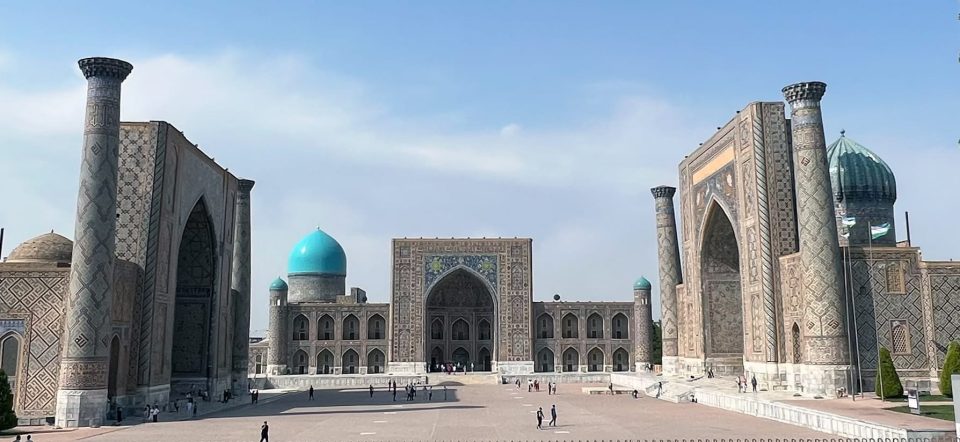
Three madrasahs face each other across one square, and that square is the reason most people fly here. Ulugh Beg Madrasah on the west side is the oldest, finished around 1420 as a university where Ulugh Beg himself lectured on mathematics and astronomy. Sher-Dor opposite it came two centuries later and is the one with the two tigers chasing deer on its portal, a rare break from the Islamic ban on depicting living creatures. Tilya-Kori between them was the last to go up, in the 1660s, and hides a mosque whose interior is covered in gold leaf. “Registan” means “sandy place”; river sand once covered the ground here. One ticket covers all three buildings and the inner courtyards, roughly $4 to $5 for a foreign visitor. I go twice when I am in town: before 9 a.m., when the courtyards are empty and the shopkeepers inside are still unpacking, and again after dark, when the facades are lit and the square outside the fence is free to walk. Nobody on site explains the inscriptions on the portals, so a guided tour of the Registan earns its price here more than anywhere else in the city.
2. Gur-Emir
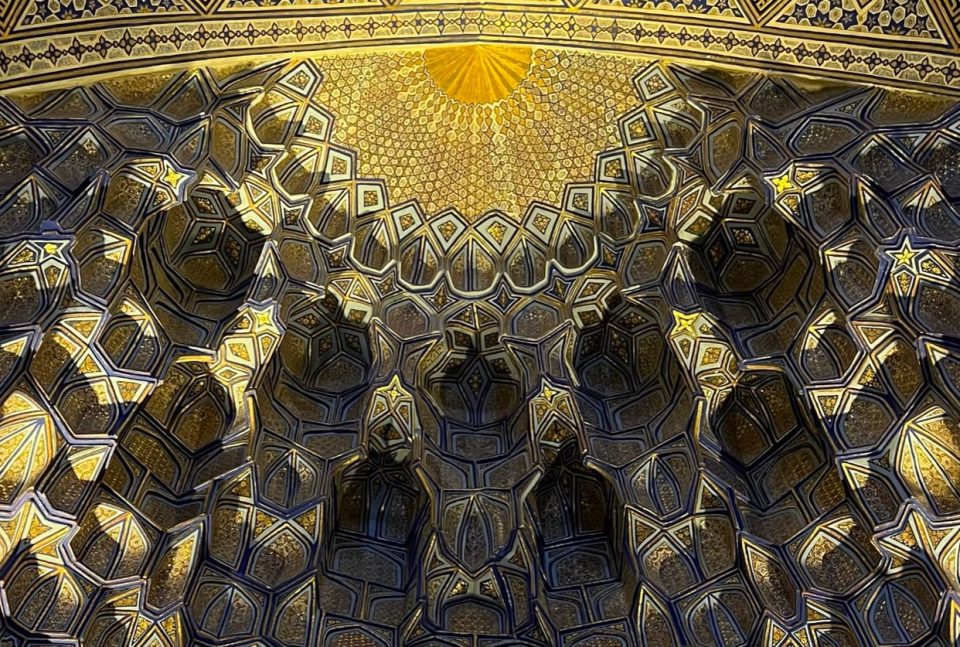
Gur-Emir is Tamerlane’s tomb, a 15-minute walk south of the Registan. He did not build it for himself. It went up in 1404 for his favourite grandson, Muhammad Sultan, who died on campaign; Tamerlane followed him into the crypt a year later, after dying on the way to invade China. Ulugh Beg lies here too. In the main hall a slab of dark green jade marks Tamerlane’s place, the largest piece of jade ever worked in Central Asia. Actual graves are in a plain crypt below, closed to visitors. Outside, the ribbed turquoise dome is the thing you remember. Inside, the walls are gilded papier-mache and painted plaster, restored in the 1990s. One story every guide tells is true: Soviet anthropologist Mikhail Gerasimov opened the tomb on 20 June 1941, and Germany invaded two days later. Allow 40 minutes, less if the tour groups have arrived, and come back after sunset when the dome is floodlit.
3. Shah-i-Zinda
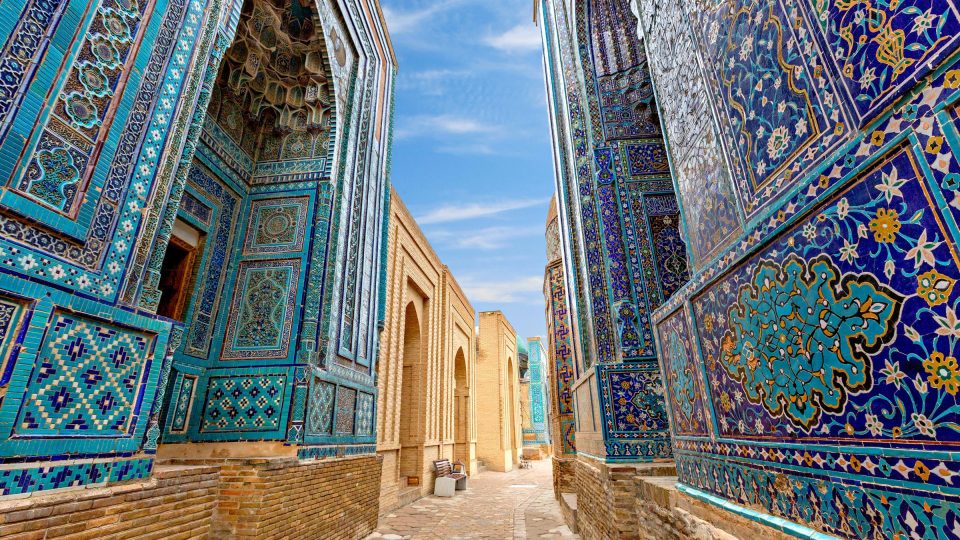
Shah-i-Zinda is a street of tombs climbing the southern slope of the Afrosiab hill, 15 minutes on foot north of Bibi-Khanum. More than 20 mausoleums line a corridor barely four metres wide, built between the 11th and 19th centuries, most of them in the Timurid decades around 1400. Each facade is a different experiment in blue: carved glazed terracotta on one, mosaic faience on the next, painted majolica on the third. Where the Registan impresses by scale, this place works at arm’s length, and the detail rewards slow walking. Its name means “the living king” and refers to Kusam ibn Abbas, a cousin of the Prophet Muhammad who, according to legend, brought Islam here in the 7th century and did not die but went underground. His shrine at the top of the complex is still a working place of prayer, so cover shoulders and knees. Tradition says you count the steps of the entrance staircase on the way up and again on the way down; matching numbers mean your sins are forgiven. Arrive before 9 a.m. and the corridor is nearly empty. By 11 the tour buses have parked outside, and photographing a facade without a stranger in frame takes patience.
4. Bibi-Khanum
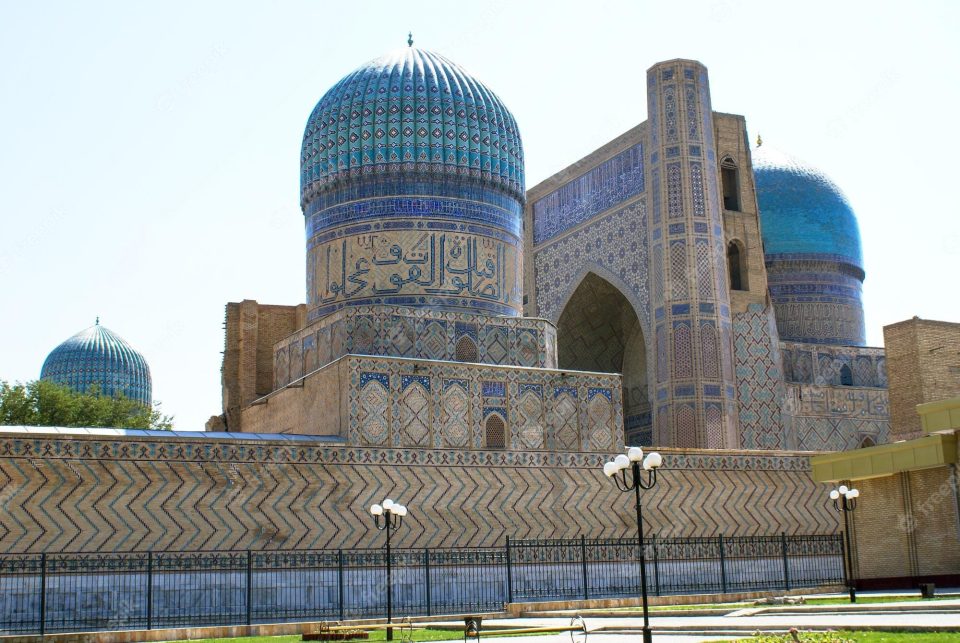
Bibi-Khanum was meant to be the biggest mosque in the Islamic world, and for a few years it was. Tamerlane ordered it in 1399 with the loot from his Indian campaign and named it after his senior wife, Saray Mulk Khanum. Ninety-five elephants brought from Delhi hauled the stone. It went up in five years, far too fast for a structure this size, and bricks were falling from the vault while worshippers still prayed below. An earthquake in 1897 finished the job, and what you see today is largely a Soviet and post-Soviet rebuild, which is why the tilework looks sharper than at Shah-i-Zinda. The entrance portal still stands about 35 metres tall, and the main dome is 40 metres across. In the middle of the courtyard sits a huge marble Quran stand commissioned by Ulugh Beg; local women crawl under it in the belief that it helps with having children. Siab Bazaar is directly across the road, so pair the two and give the mosque about half an hour.
5. Ulugh Beg Observatory
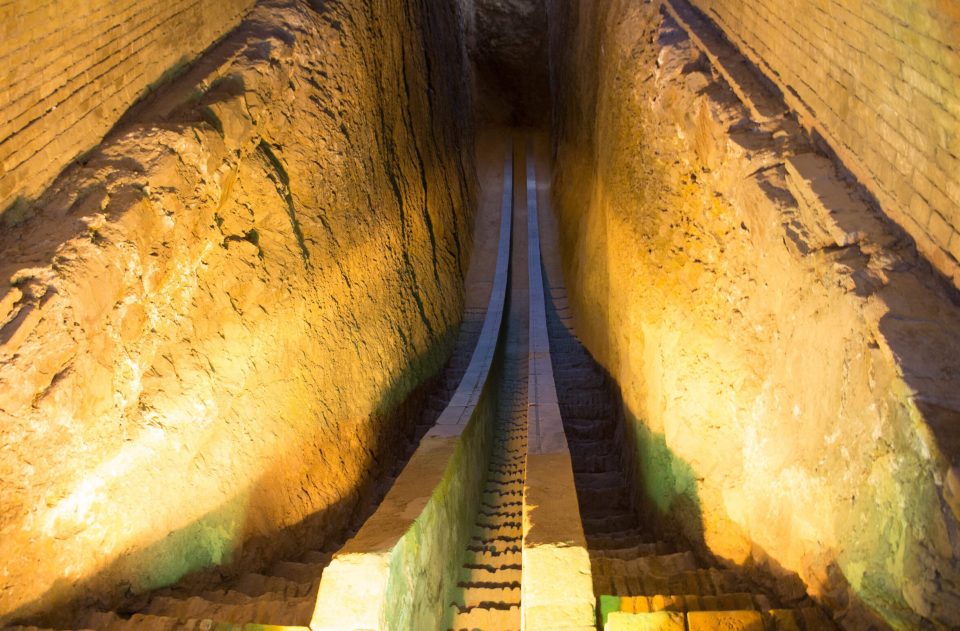
Ulugh Beg, Tamerlane’s grandson, cared more about stars than conquest. In the 1420s he built a three-storey round observatory on a hill northeast of the city and used it to compile a catalogue of 1,018 stars, the most accurate one produced anywhere between Ptolemy and Tycho Brahe. After his son had him murdered in 1449, religious conservatives razed the building and its location was forgotten for 450 years. Russian archaeologist Vasily Vyatkin found it in 1908 by working from old land deeds. What survives is the underground half of the instrument that made the measurements: an 11-metre marble arc sunk into the rock, part of a sextant that originally had a radius of 40 metres. You walk down a trench and look at it. A small museum next door has models of the original building and copies of the star tables. Twenty minutes is enough. It is about 3 km from the Registan, too far to walk in summer heat; a Yandex Go taxi costs a dollar or two. Several Samarkand day tours on Viator bundle the observatory with Afrosiab and Shah-i-Zinda, which saves the taxi hopping.
6. Afrosiab
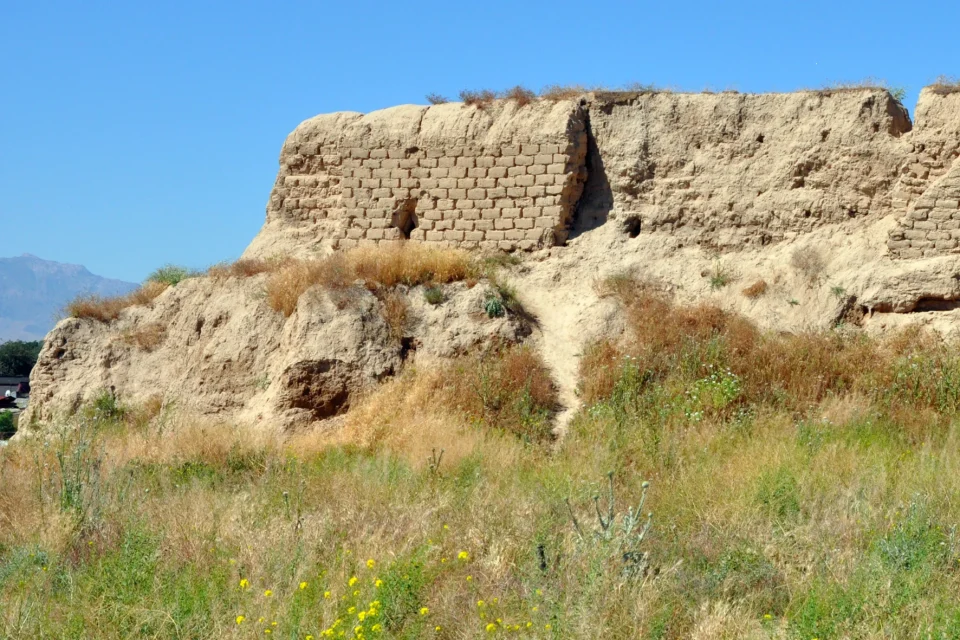
Afrosiab is the original Samarkand, the city Alexander took in 329 BC and Genghis Khan destroyed in 1220. After the Mongols nobody rebuilt on the hill; the survivors moved south, to where the Registan now stands, and the old town slowly turned into 200 hectares of bare yellow mounds. Walking the mounds themselves is for archaeologists. For everyone else the reason to come is the Afrosiab Museum at the foot of the hill, and specifically one room: the 7th-century murals found here in 1965, known as the Hall of the Ambassadors. They show a Sogdian king receiving envoys from China, Korea and Persia, painted a century before Islam arrived. Faces, silk robes and horses survive in enough detail to count the pearls on a belt. Nothing else from Sogdian Samarkand comes close. The museum sits on the road between Shah-i-Zinda and the observatory, so it slots naturally into the second day. Any of the guided Samarkand tours on GetYourGuide that cover the northern sites will stop here; on your own, 45 minutes covers it.
7. Samarkand Siab Bazaar
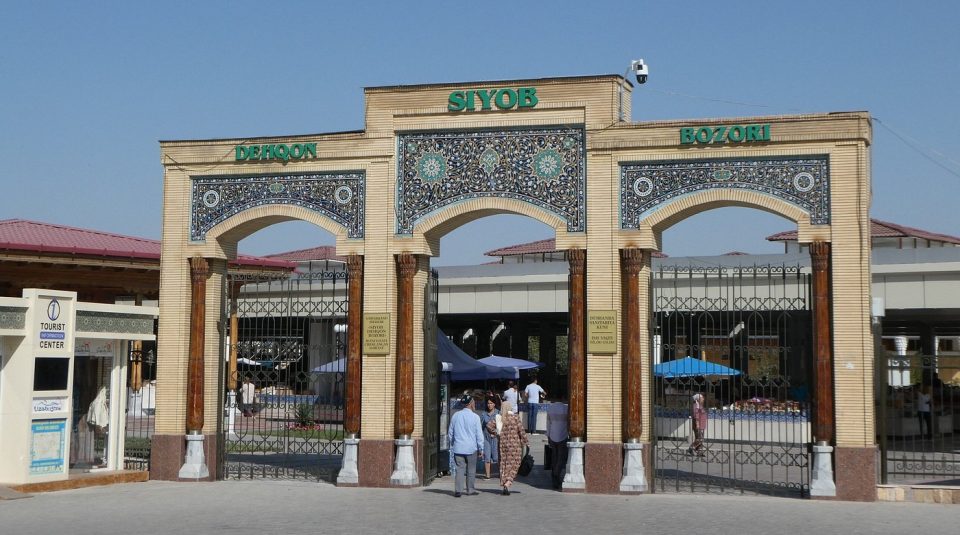
Siab Bazaar is the city’s main food market, under a long covered hall and the open rows around it, right beside Bibi-Khanum. Go in the morning, when the bread is still warm and the aisles are full of locals rather than tour groups. Samarkand bread is the thing to buy: dense round loaves stamped in the centre, famous across Uzbekistan for staying edible for weeks. Sellers will tell you it tastes different anywhere else because of the water, and in my experience the loaves from the stalls near the mosque entrance do travel well. Beyond bread, the covered rows sell dried apricots and raisins by the kilo, walnuts, halva cut from slabs, kurt (salty dried cheese balls) and spice mixes for plov. Prices are marked rarely and bargaining is mild; a 10 to 20 percent discount is normal, more is not. Food stalls at the back serve samsa and tea for a dollar or so. If you want someone to explain what you are eating, a food tour of Samarkand usually starts here. The market is also a good place to orient yourself for shopping and other activities in Samarkand, since the ceramics and suzani stalls on the bazaar’s edge give you a baseline for prices before you buy anything near the Registan.
Fitting Seven Sites Into Two Days
Day one is all on foot: Registan at opening, Gur-Emir before lunch, then up Tashkent Street to Bibi-Khanum and the bazaar in the afternoon, and back to the Registan after dark for the lights. Day two covers the north: taxi to Shah-i-Zinda for opening, walk to the Afrosiab Museum, taxi on to the observatory, and you are done by early afternoon. Stay within walking distance of the Registan if you can; the lanes of the old town between the Registan and Gur-Emir are full of family guesthouses, and hotels in Samarkand in that area start at about $30 a night for a clean double with breakfast. If you prefer not to plan the logistics yourself, Samarkand city tours on GetYourGuide cover all seven stops in a long day, with lunch at a plov centre in between. From Tashkent, the Afrosiyob high-speed train takes about two hours and ten minutes and sells out days ahead in spring and autumn, so book it before you book the hotel.


