
Five sections of the Great Wall lie within two hours of Beijing, and they differ more than most visitors expect. Badaling has escalators and crowds, Mutianyu has a toboggan, Jinshanling has ruined towers and almost nobody on them. Beyond the Wall, a ring of imperial tombs, a rebuilt canal town and two enormous palace parks fill another three or four days. This guide covers how to choose a section, what each trip costs in yuan and dollars, which bus to take, and where to go once the Wall is done.
Prices below are the standard published rates. Chinese attractions raise fees in peak season, and most now require an online reservation with a passport number. Book a day or two ahead, and for the Forbidden City a week ahead.
Which Section of the Great Wall to Visit from Beijing

Three questions settle the choice. How much walking do you want, how much company can you tolerate, and how much time do you have for the road. Badaling is the answer for people with half a day and a train ticket. Mutianyu suits families and anyone who wants restored wall without the Badaling crush. Jinshanling and Simatai are for hikers who will accept a three-hour drive each way in exchange for towers with grass growing through the bricks. A fourth option, Huanghuacheng, has a section that runs into a reservoir, but transport is awkward and it is best left for a second visit.
Badaling for First-Timers

Badaling sits 80 km northwest of the city and has been the official showcase since 1957. Nixon walked here, so did most heads of state since, and the section is restored to the point where the stone looks new. Walkways are wide, handrails run along the steep parts, and a cable car covers the climb for anyone who wants to skip the stairs. Entry costs 40 yuan from April to October and 35 yuan in winter, about $5. The cable car is around 140 yuan round trip. Reservations are compulsory and open seven days ahead on the official WeChat account, which is easier with a Chinese-speaking friend or a guided Badaling tour that handles the booking.
Crowds are the price of convenience. On weekends and national holidays the north towers turn into a slow queue, and the famous photos of a wall covered in people are taken here. The fix is timing. Gates open at 6:30 in summer, and before 9 am the wall is close to empty. Getting there on your own is simple: bus 877 leaves from Deshengmen, north of the second ring road, costs 12 yuan and takes about 90 minutes. Faster is the high-speed train from Beijing North or Qinghe station to Badaling Great Wall station, 30 minutes for about 25 yuan, followed by a short shuttle to the gate.
Mutianyu for Families and Views

Mutianyu lies 70 km northeast in Huairou district and gets perhaps a fifth of Badaling’s visitors. Restoration is just as thorough, but the setting is greener: the wall climbs through forest and the 22 watchtowers stand close together, so the views change every few minutes. Entry is 40 yuan. From the ticket office a shuttle bus, 15 yuan round trip, runs to the foot of the wall, then a cable car or chairlift goes up. Coming down, most people take the toboggan, a metal chute with a wheeled sled and a hand brake. Cable car up and toboggan down together cost about 140 yuan. Children need to be at least 1.3 m tall to ride alone.
Public transport takes patience. Bus 916 Express from Dongzhimen goes to Huairou Beidajie in about an hour, then a taxi or local bus H23 covers the last 20 km. A seasonal tourist bus, marketed as the Mubus, leaves Dongzhimen around 8 am and returns mid-afternoon for roughly 80 yuan round trip, which removes the transfer. Anyone travelling with small children or older parents usually finds a private Mutianyu tour with hotel pickup worth the extra cost, since the whole trip door to door takes eight hours. Walk east from tower 14 toward tower 20 for the steepest and emptiest stretch.
Jinshanling and Simatai for Hikers

Jinshanling is 130 km northeast, just across the border in Hebei province. Its 10 km of wall run over a ridge with 67 towers, half restored and half left as the Ming builders’ successors abandoned them. Entry is 65 yuan, a cable car covers the first climb for 40 yuan one way, and the standard walk from the Zhuanduokou gate east to the East Five-Window Tower takes three to four hours with a lot of uneven steps. On a weekday you may pass a dozen people. Direct buses from Wangjing West run on weekends in season, and a private car costs 800 to 1,000 yuan for the day. The old through-hike to Simatai is closed at the provincial border more often than it is open, so plan Jinshanling as a loop.
Simatai, 120 km from Beijing, is the only section open at night. Entry goes through Gubei Water Town, a resort built in 2014 at the foot of the wall, and the two are sold as a package. Simatai’s east section is steep, with towers on knife-edge ridges, and only ten of them are open to walkers. Daytime tickets require a reservation through the Gubei website. The night walk, with the towers lit until about 10 pm, is the reason most people come. Expect crowds at the lower towers on Saturday evenings. Direct shuttle buses from Dongzhimen to Gubei cost 48 yuan each way and take about two hours.
What a Great Wall Day Trip Costs

Budgets vary by a factor of ten depending on transport and section. At current rates one dollar buys a little over seven yuan.
- Entrance ticket. 40 yuan at Badaling and Mutianyu, 65 at Jinshanling, 40 at Simatai plus 140 for Gubei Water Town. Roughly $5 to $25.
- Cable car, chairlift or toboggan. 100 to 140 yuan round trip, $14 to $20. Walking up is free everywhere and takes 30 to 45 minutes.
- Public bus or train. 12 to 30 yuan each way, under $5. Cheapest by far, slowest on the return when everyone leaves at once.
- Group tour. 300 to 800 yuan per person, $40 to $110, depending on whether lunch, tickets and a second stop are included. Read the itinerary for factory or jade shop visits, which pad out the cheaper tours.
- Private car with driver. 600 to 1,200 yuan for the day, $80 to $160, split between up to four people. Agree the price, the waiting time and the sections in writing before departure.
A solo traveller on the bus to Mutianyu with a cable car ticket spends about 250 yuan, or $35, for the day. A couple with a private driver to Jinshanling spends closer to 1,200 yuan. Water on the wall costs 10 yuan a bottle, three times the city price, so carry your own.
Other Day Trips from Beijing

Beijing was the imperial capital for most of the last 700 years, and the emperors left tombs, gardens and altars in a wide ring around the city. Two of the four places below are outside the city and need a car. The other two are inside the subway network and count as day trips only because of their size: each covers more ground than the Forbidden City.
Eastern Qing Tombs

Five Qing emperors, including Kangxi and Qianlong, lie in a valley near Zunhua, 125 km east of Beijing, together with 15 empresses and more than a hundred concubines. The necropolis has been on the UNESCO list since 2000 and is far less visited than the Ming Tombs nearer the city. A spirit way lined with stone elephants and camels leads to the tomb of the first emperor buried here, Shunzhi. Two tombs are open underground: Qianlong’s, with Buddhist sutras carved on every wall of the burial chamber, and Cixi’s, where the Empress Dowager had the halls decorated in gold leaf and the carved dragons placed below the phoenixes, reversing the usual order. Both were looted by a warlord’s troops in 1928, and the story is told in a small museum on site. Entry is around 110 yuan. Public buses involve two changes and take over three hours, so a hired car at about 900 yuan for the day or a group tour is the realistic way. Allow four hours on site.
Gubei Water Town

Gubei is a purpose-built resort, not an old town, and it helps to know that in advance. The same company that runs Wuzhen near Shanghai built it in 2014 at the foot of Simatai, with canals, stone bridges, grey-brick courtyards and a hot spring hotel. Entry is 140 yuan. Inside are workshops for kites, dyeing and rice wine, boat rides on the canals, and dozens of restaurants at resort prices. What makes it worth 140 km of driving is the combination with the wall: spend the afternoon in town, take the cable car up Simatai at dusk, walk the lit towers, and come back down for dinner by the water.
Staying overnight changes the experience. Hotels inside the town cost from about 800 yuan, and guests get the lanes to themselves after the day visitors leave at 9 pm. In summer there is a light show on the water. The shuttle from Dongzhimen runs several times a day, and the last one back leaves around 9 pm, so day-trippers need to choose between the night wall and the bus home.
Summer Palace
Yiheyuan covers 290 hectares in the northwest of the city, and three quarters of that is Kunming Lake. Emperors came here from the Forbidden City to escape the summer heat, and the layout is designed for walking: the Long Corridor runs 728 m along the north shore with more than 14,000 painted scenes on its beams, Longevity Hill rises behind it with the Tower of Buddhist Incense on top, and the Seventeen-Arch Bridge crosses to an island on the far side. The park ticket is 30 yuan in season and 20 in winter. A combined ticket at 60 yuan adds the tower, the Suzhou Street shopping canal and the Wenchang Gallery. Pedal boats on the lake rent for about 80 yuan an hour.
Subway line 4 to Beigongmen leaves you at the north gate, which is the quiet entrance. Most tour buses use the east gate, so walking the park from north to east means moving against the flow. Six hours is a reasonable stay with a lunch break. A Summer Palace guided walk takes about three hours and explains what the corridor paintings show, which is otherwise hard to work out. Tours that combine Mutianyu and the Summer Palace in one day exist, but they give each place about two hours, which shortchanges both.
Temple of Heaven
Tiantan is a 273-hectare park south of the old city where Ming and Qing emperors performed the winter solstice sacrifice for a good harvest. Its main building, the Hall of Prayer for Good Harvests, is a triple-roofed round hall 38 m high built entirely of wood on 28 pillars, without a single nail. South of it lie the Imperial Vault of Heaven with its Echo Wall and the open Circular Mound Altar, where a whisper from the center stone carries oddly well. The park ticket is 15 yuan, and the combined ticket for the buildings is 34 yuan in season.
Arrive between 7 and 9 am. Retired Beijingers use the park for tai chi, sword forms, choir practice and card games under the ancient cypresses, and the east gate area is livelier than anything in the tourist halls. Subway line 5 to Tiantandongmen puts you at that gate. Three hours cover the site. A Temple of Heaven tour with a guide is useful mainly for the numerology of the buildings, where the number of pillars, steps and stones encodes the calendar. Combined with the Pearl Market across the street, the temple fills a half day, leaving the afternoon for the hutongs.
Planning a Day Out from Beijing

Logistics around Beijing are reliable but not always intuitive for a first visit. A few points save time and money.
- Transport.
- Bus and train. Cheapest option, and the Badaling train has made it painless. Buses to Mutianyu involve a transfer in Huairou. Return buses fill up between 3 and 5 pm, so either leave early or wait until 6.
- Group tours. Easiest for anyone without Chinese, since transport, reservations and tickets are handled. Check that the itinerary has no shopping stops and that the guide speaks English rather than relying on an app.
- Private driver. Most flexible for three or four people. Hotels arrange cars, as do the Didi app and the tour platforms. Drivers usually wait at the car park, so combining two sites in one day is easy.
- Food and water. Carry at least a liter of water per person and something to eat. Kiosks exist at Badaling and Mutianyu but not on the wall itself, and Jinshanling has nothing beyond the gate. Restaurants near the car parks serve noodles and dumplings at fair prices.
- Clothes and shoes. Steps on the wall range from 10 cm to 40 cm in height and are polished smooth. Wear shoes with grip. Even in June, wind on the ridge makes a light jacket useful, and in winter the wall is exposed and bitterly cold.
- When to go. April, May, September and October have clear skies and mild temperatures. Late October brings red maples at Mutianyu and Badaling. Avoid the first week of October and the week around Chinese New Year, when domestic tourism peaks. July and August are humid with afternoon storms. Winter is cold but empty, and snow on the wall is a rare, worthwhile sight.
- Payment. Alipay and WeChat Pay accept foreign cards since 2023, and both work at every ticket office and bus. Cash still helps at village restaurants near the wall. Bring your passport: it is checked at most ticket gates.
- Where to stay in Beijing. Day trips start early, so a base near a subway line 2 station such as Dongzhimen or Jishuitan cuts 30 to 40 minutes off each morning. Wangfujing and the Temple of Heaven area also work for the city sights. Rates run from about $30 for a courtyard hostel to $200 for an international chain. It is easiest to compare Beijing hotels by district before choosing, since a cheap room in the far west adds an hour to every trip.
Fitting Day Trips into a Beijing Itinerary

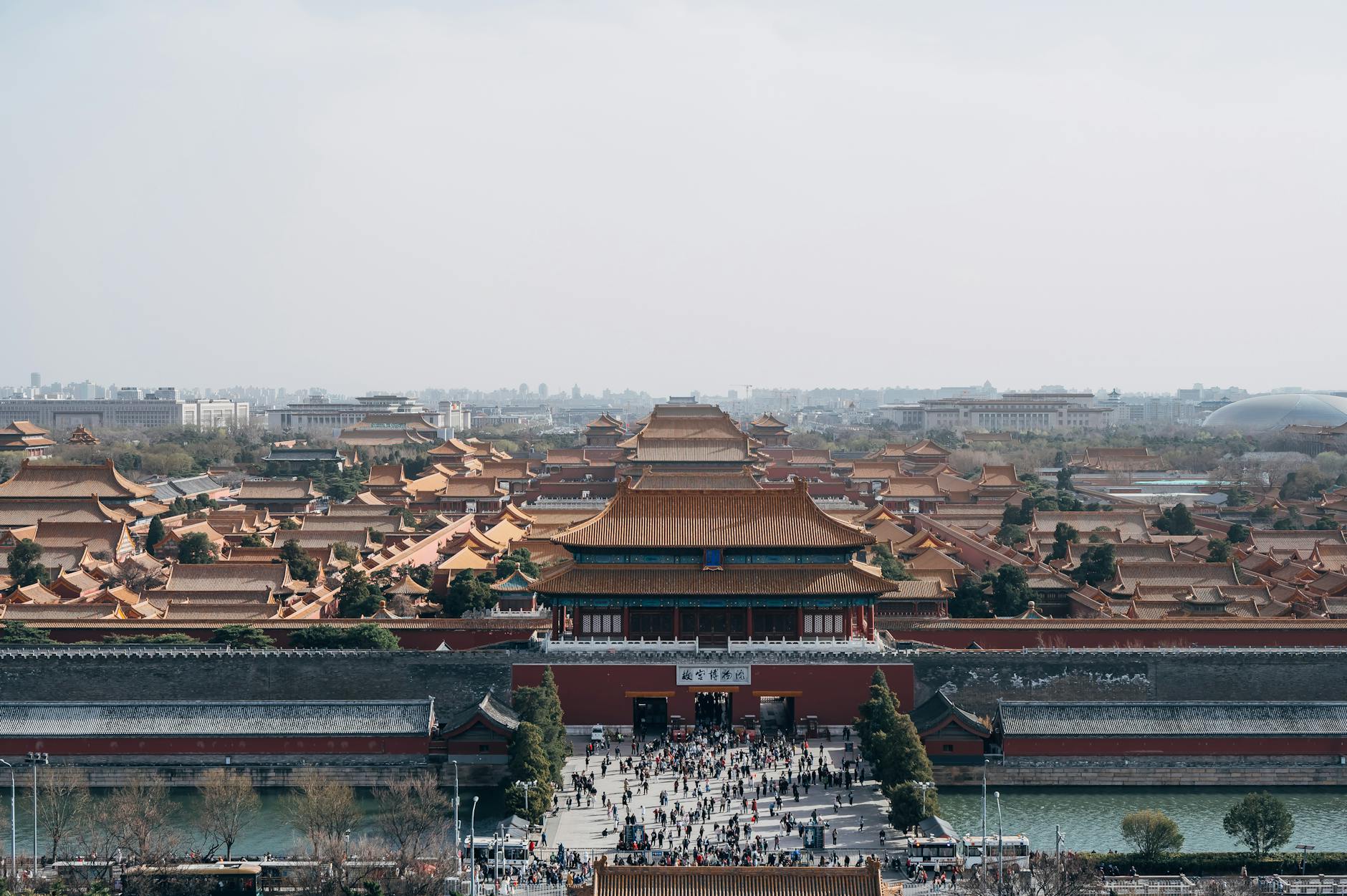
Beijing’s central sights need three days on their own. The Forbidden City takes a full morning and sells out a week ahead, especially since visitor numbers were capped at 40,000 a day. A guided Forbidden City tour solves the ticket problem, and a guide also helps in a complex with 900 buildings and almost no signage. Tiananmen Square, the Drum and Bell Towers, the hutongs around Houhai and the Lama Temple fill the rest.
With five days, a workable order is: day one the Forbidden City and Jingshan Park, day two the Temple of Heaven in the morning and hutongs in the afternoon, day three Mutianyu, day four the Summer Palace, day five Jinshanling or the Eastern Qing Tombs. With seven days add Gubei with an overnight stay and a second wall section. Put the wall days in the middle of the trip, when jet lag has passed and an early start is realistic.
Day trips also show a side of northern China that the capital hides. Villages below Mutianyu grow chestnuts and sell them roasted at the roadside in autumn. Huairou reservoir has fish restaurants where the trout comes out of a tank. The road to Jinshanling passes through Miyun, where orchards replace apartment blocks. None of this is on the standard tours, but a driver will stop if asked.
Weather decides a lot. Beijing’s air is clearest after a windy day, and the wall is worth seeing only when the ridges beyond it are visible. Check the forecast the night before and move a wall day if the air quality index passes 150. Museum days and palace days are less sensitive to haze.
Finally, distances are longer than a map suggests. Traffic on the airport expressway and the roads north to Huairou slows to a crawl on Friday afternoons and Sunday evenings. A trip advertised as 90 minutes can take three hours on the wrong day. Weekday departures before 7:30 am avoid most of it.
Sample Plan for One Wall Day

For a first visit with one free day, Mutianyu is the safe choice. Leave Dongzhimen at 7 am on the tourist bus or with a driver, arrive at the ticket office by 8:30, take the cable car up to tower 14 and walk east to tower 20, which is the steep part with the best views. Come back to tower 6 for the toboggan by noon, eat in the village at the bottom, and be back in Beijing by 3 pm with the afternoon free for the Drum Tower and Houhai. Total cost with bus, ticket, cable car and toboggan is about 250 yuan, or $35.
For a longer stay, follow the three-day imperial trail through Beijing for the city sights and slot the trips above into the days that follow. Book train and attraction reservations as soon as dates are fixed, and if you are still comparing dates, flights to Beijing are usually cheapest for midweek arrivals in late October and March, which also happen to be good months for the wall.


