
A long layover in Beijing can turn into a free extra country on your trip. China lets citizens of 55 countries, including the United States, Canada and Australia, enter without a visa for up to 240 hours while in transit to a third destination. That is ten days, enough for the Great Wall, the Forbidden City and a few duck dinners, not just a glance at the terminal shops.
Many passengers never leave the airport. Stories about strict border officers and the language barrier put them off, so they spend eight hours in a departure lounge. Below is how the transit rule works in practice, where the special counter hides in each Beijing airport, and what fits into a layover of 10, 24 or 48 hours.
One note before the details. Since late 2024 China has also granted ordinary 30-day visa-free entry to most European Union countries, the United Kingdom, Japan, South Korea and several others. If your passport is on that list, you do not need the transit scheme at all and can skip the special counter. The 240-hour rule matters most for American and Canadian passport holders, who still need a visa for a normal visit.
How the 240-Hour Visa-Free Transit Works
Until December 2024 the limit was 144 hours, and older guides and airline websites still quote that figure. The current scheme gives 240 hours, counted from midnight after the day you arrive. To qualify, your itinerary has to follow one simple pattern:
Country A ✈️ Beijing ✈️ Country C
- Country A is where your flight to Beijing departs from, say Germany or the United States.
- Beijing is your transit point. Under the current rules you may also leave China through a different city, for example fly into Beijing and out of Shanghai.
- Country C is a different country or region from A. Thailand, Japan, South Korea, Hong Kong and Macau all count. Hong Kong and Macau are treated as separate regions for this purpose.
A round trip such as London to Beijing and back does not qualify, because it is not a transit. Officers check the onward ticket carefully, so the Country C flight must be confirmed and paid for. Within China you can now move between the 24 provinces covered by the scheme, which was not allowed under the old 144-hour rules. The simplest case remains a direct flight into Beijing and a direct flight out to your next country.
What Documents You Need
At the transit counter the officer will ask for three things:
- Passport valid for at least three months beyond your departure from China, with a blank page for the permit sticker.
- Onward ticket with a confirmed date, departing within 240 hours, to a third country or region. Have it printed or saved offline, and make sure the confirmation is in English.
- Hotel confirmation if you stay overnight. Officers do not always ask, but a traveller without any address in Beijing invites extra questions. Chinese hotels also register every foreign guest with the police, so pick one that accepts foreigners; the big chains and anything on international booking sites do.
What to Do at the Airport
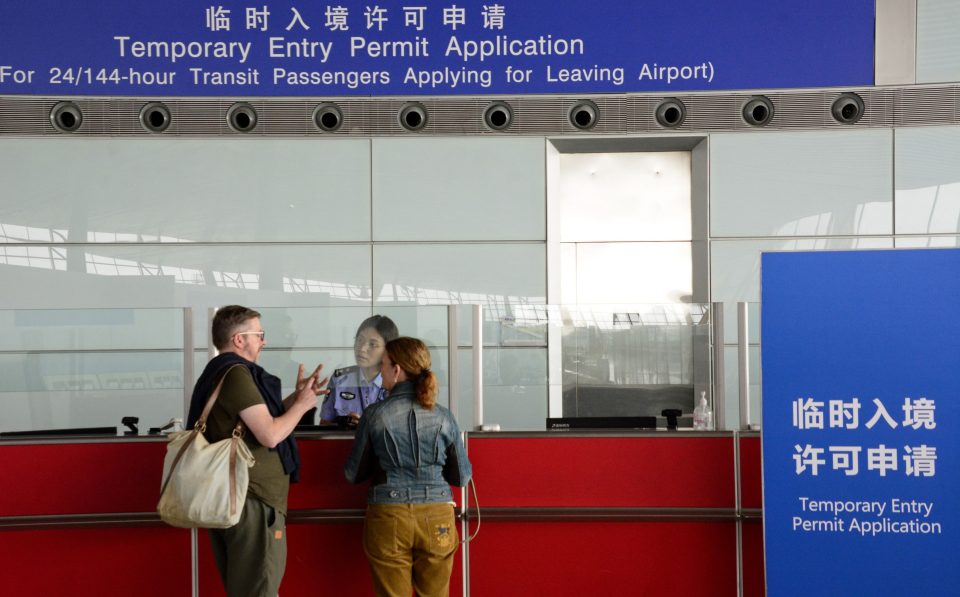
Beijing has two international airports: Capital (PEK) north-east of the city and the newer Daxing (PKX) far to the south. Most long-haul carriers from Europe and North America use Capital, Terminal 3 in particular. The transit procedure is the same at both.
- Do not follow the crowd. Most passengers walk straight to the regular immigration booths. Those officers cannot issue a transit permit and will send you back.
- Look for the sign reading “24/240-hour Visa-free Transit” or simply “Visa-free Transit”. The counters sit off to one side of the main immigration hall, usually at the far end.
- Fill in the arrival card. Paper cards are available at the counter. Write both flight numbers, your arrival flight and the onward one, plus your hotel address.
- Collect the permit. The officer checks your onward ticket, takes fingerprints and a photo, and places a Temporary Entry Permit sticker in your passport with the exit deadline printed on it.
- Pass immigration. With the sticker in place you go through the normal booths, collect any luggage and walk out into the arrivals hall.
Timing. Allow two to three hours from landing to the city train. When several long-haul flights land together, the transit queue at Capital can take over an hour on its own. With a layover under eight to ten hours, a trip into town leaves almost no time at the sights, and a capsule hotel or lounge in the terminal is the saner choice.
Getting from the Airports to Downtown
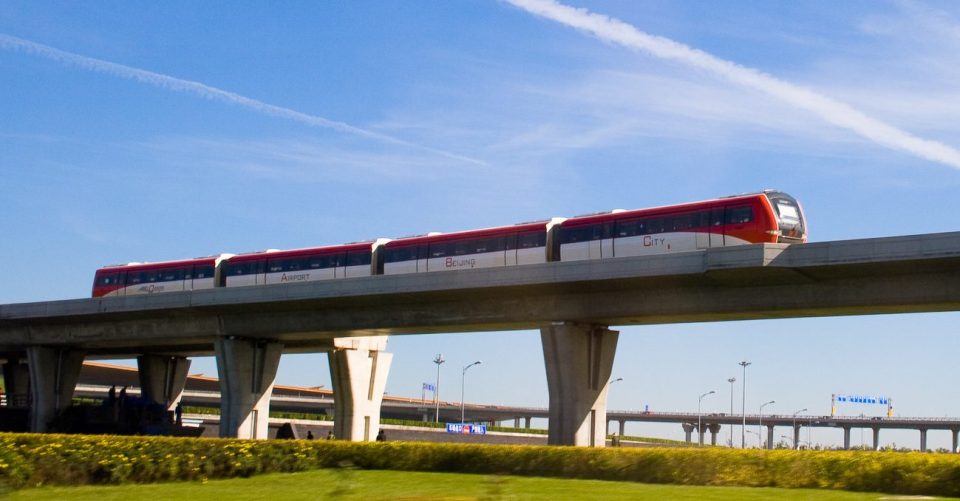
Both airports have a dedicated rail link into the subway network, and in both cases the train beats a taxi during the day, when the airport expressways jam for hours. Taxis make sense late at night or with a lot of luggage. Ignore anyone offering a ride inside the terminal and use the official rank outside instead.
From Capital Airport (PEK)
Take the Airport Express, a subway line that stops at Terminals 2 and 3.
- Route. Sanyuanqiao, then Dongzhimen and Beixinqiao. At Dongzhimen you change to Line 2, the loop line that circles the old city.
- Time. 20 to 30 minutes to Dongzhimen.
- Fare. 25 yuan, about 3.50 dollars, paid by card at the machine or with Alipay.
From Daxing Airport (PKX)
Daxing lies 46 km south of Tiananmen, so the distance is real, but the transport is new and fast.
- Daxing Airport Express. Runs at up to 160 km/h and reaches Caoqiao station in 19 minutes, where you switch to Line 10 or Line 19 for the centre. The fare is 35 yuan. Allow about an hour door to door to the Forbidden City area.
- High-speed rail. Trains from the station under the terminal reach Beijing West in about 30 minutes, useful if your hotel is on the west side of town.
With suitcases or children the subway gets tiring: long transfer corridors and few lifts at older stations. A private transfer booked in advance through Trip.com or a similar service means a driver waits in arrivals with a sign, which removes the taxi queue and the language problem in one go.
What Fits into Your Layover
Count your free time honestly. Subtract two to three hours for the transit counter and the ride into town, then another three hours at the end for the ride back and security. A 12-hour layover leaves about six hours in the city. Book Forbidden City tickets days in advance through the official account, because they sell out and require passport details; a guided Forbidden City tour that includes the entry ticket is the easiest way around that for a one-day visit.
Express Introduction (10-15 Hour Layover)
Go straight to the centre and stay there. Everything below sits within a 2 km radius.
- Tiananmen Square and Gate. Entry to the square requires a free reservation and a passport check, so book it the day before through the official mini-app or walk along Chang’an Avenue for the view of the gate instead.
- Jingshan Park. Climb the hill opposite the north gate of the Forbidden City. From the pavilion on top the whole palace complex lies below you, and the entry ticket costs 2 yuan. It is the best hour you can spend on a short visit.
- Peking duck. Siji Minfu near the palace is the local favourite, expect a queue at dinner time. Quanjude is the old state chain, less fashionable but with no wait. A whole duck for two costs about 300 yuan at either.
- Back to the airport no later than three hours before departure.
Mini-Vacation (24 Hours or More)
With an overnight stay the Great Wall comes into reach.
- Day. The Great Wall at Mutianyu, 70 km north of the city. Count on five to six hours including the drive. A Mutianyu day tour with hotel pickup saves the hassle of the tourist bus, which leaves from Dongzhimen only in the morning.
- Evening. Walk the Qianmen pedestrian street south of Tiananmen, or head to Sanlitun for bars and restaurants that stay open past midnight.
- Morning before departure. The Temple of Heaven park opens at 6 am, and the first two hours belong to locals practising tai chi, dancing and flying kites. The park ticket costs 15 yuan, the combined ticket with the temple buildings 34.
Where to Stay During Transit
The choice comes down to your departure time. With a flight before 10 am, sleep at the airport and skip the morning traffic. With a later departure or a two-day stay, a hotel downtown gives you an evening and a morning in the city for the same money. Both options below are the ones that pop up most in transit forums, and both accept foreign guests without fuss.
Near the Airport for an Early Flight
Airport hotels in China tend to be newer and better soundproofed than their European counterparts, and most run a free shuttle to the terminals every 15 to 30 minutes.
- Hilton Beijing Capital Airport (PEK). Linked to Terminal 3 by a covered walkway, about two minutes on foot. Thick windows, blackout curtains, a 24-hour gym, and rates that often drop below 100 dollars midweek.
- Jianguo Hotel Daxing Airport (PKX). Built inside the terminal complex, so you walk from your room to check-in without going outside. The practical choice for any Daxing departure before 9 am.
Downtown for Sightseeing
Aim for Wangfujing or Dongzhimen. Wangfujing puts the Forbidden City within walking distance, and Dongzhimen is where the Airport Express drops you, so a hotel there saves a subway change with luggage.
- Park Plaza Beijing Wangfujing. A modern tower a few minutes from Wangfujing subway station. Drop the bags and you are 20 minutes on foot from the palace’s east gate.
- Prime Hotel Beijing Wangfujing. An older five-star with large rooms and a 15-minute walk to the Forbidden City. Prices are usually a notch below the international chains nearby.
Luggage, Connectivity and Money
Suitcases.
If your bags are not checked through to the final destination, both airports have left-luggage counters in the arrivals halls. Expect 20 to 50 yuan per item per day depending on size. Leave everything but a day bag there; the Great Wall has 1,000 steps and no cloakroom.
Internet.
Google, WhatsApp and Instagram are blocked on Chinese networks. Three ways around it:
- Option A. Install a travel eSIM before you fly, for example from Airalo. Data routes through Hong Kong or Singapore, so the usual apps work without a VPN. A 1 GB plan for a week costs around 5 dollars.
- Option B. Use your home operator’s roaming. Roaming traffic also bypasses the filters, but check the daily price first.
- Option C. Airport Wi-Fi is free but needs a password from a kiosk that scans your passport, and the blocks still apply once you are connected.
Cash.
Hardly anyone in Beijing pays with notes. Download Alipay or WeChat Pay before the trip, add a Visa or Mastercard, and the phone pays for everything from the subway to a bottle of water. Keep 200 to 300 yuan in cash anyway, about 30 to 40 dollars, for an older taxi driver or a park ticket booth with a dead scanner. Airport ATMs accept foreign cards; bank branches in town are slower.
The short checklist, then: onward ticket to a third country within 240 hours, passport valid three months beyond that, hotel address written down, Alipay installed, and three hours at each end for the airport. With those in place, a Beijing stopover costs you nothing in visa fees and gives you the Great Wall on the way to somewhere else.


