
Singapore is 50 km across, and the MRT covers nearly all of it, so no hotel is truly far from anything. What the neighborhood decides is how much you pay, what you see when you step outside, and whether dinner is a S$5 hawker plate or a S$50 restaurant bill. Prices in this guide are in Singapore dollars; S$100 is about US$75. Seven areas cover almost every kind of trip, from a first visit on a splurge budget to a week of eating cheaply in the eastern suburbs.
Marina Bay for the Skyline

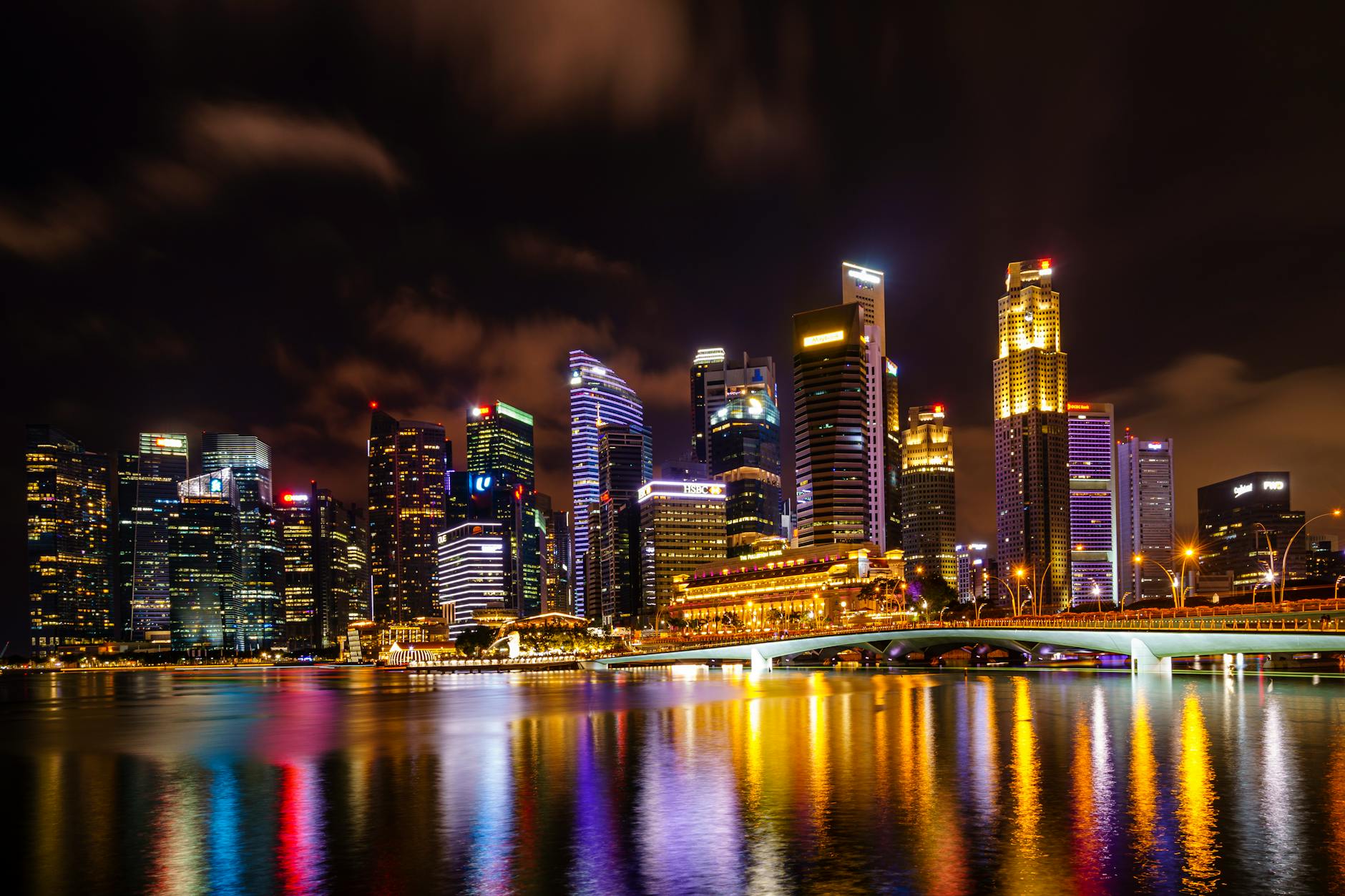
Marina Bay is the view from every postcard and the natural base for a first visit on a generous budget. Gardens by the Bay with its Supertrees, the ArtScience Museum, the Helix Bridge and the Merlion are all within a 20-minute walk of each other, and the nightly light show at 8 and 9 pm is free from the waterfront promenade. The famous rooftop infinity pool belongs to Marina Bay Sands and is open to hotel guests only; everyone else gets the SkyPark observation deck for S$32. Bayfront and Marina Bay MRT stations sit at opposite ends of the district. Readers planning a luxury stay in Singapore will find most of the candidates within a kilometer of here.
Rooms around the bay start at about S$400 a night and climb past S$800 in December and during the Grand Prix in September. What you get for that is the view: a bay-facing room means waking up to the Supertrees or the whole skyline across the water. PARKROYAL COLLECTION Marina Bay is the one to look at first, a hotel built as a garden with 2,400 plants in its atrium and a pool deck facing the bay. Pan Pacific Singapore, next to Marina Square, has the same views from higher floors and a slightly lower price. Both are linked to the malls by covered walkways, which matters when the afternoon storm hits.
Pros and Cons of Marina Bay

Pros:
- Marina Bay Sands, Gardens by the Bay and the Singapore Flyer within walking distance.
- Bay and skyline views from most upper-floor rooms.
- Three MRT stations on three different lines.
- Rooftop bars and the free nightly light show on the doorstep.
- Covered walkways between hotels, malls and stations.
Cons:
- The highest room rates in the city, often double the Chinatown price for a comparable hotel.
- Crowds on the promenade every evening and tour groups all day.
- Cheap food is scarce; the nearest hawker center is Lau Pa Sat, a 15-minute walk.
Who it suits: first-time visitors with two or three nights who want the big sights on foot, couples on a special trip, and anyone whose photo of Singapore has to include that skyline from the window.
Colonial District for History and Quiet Streets

Ten minutes on foot from the bay, the Civic District is where Singapore’s British century survives: the Padang cricket ground, St Andrew’s Cathedral, the former Supreme Court and City Hall now joined as the National Gallery, and the National Museum on Stamford Road. Streets are wide, shaded and quiet after office hours. City Hall MRT connects two lines, and Clarke Quay with its riverside bars is a 10-minute walk west. Most of the buildings have free ground floors, so a self-guided loop of the district takes a morning and costs nothing.
Hotels here are expensive but in a different way from Marina Bay: age and service rather than height. Raffles Singapore opened in 1887, is all suites, and starts around S$1,000 a night. Non-guests can still walk through the lobby arcade and order a Singapore Sling at the Long Bar, where the cocktail was invented; expect about S$40 for the drink. Carlton Hotel across the road and Swissotel The Stamford, one of the tallest hotels in Southeast Asia at 226 meters, offer four- and five-star rooms in the S$300 to S$450 range with the same location.
What to Know About Staying in the Civic District

Pros:
- National Gallery, National Museum, Asian Civilisations Museum and Fort Canning all within 15 minutes on foot.
- City Hall and Bras Basah MRT stations on four lines between them.
- Marina Bay and Clarke Quay both reachable on foot, so no transit needed in the evening.
- Quieter nights than any other central district.
- Older hotels with large rooms and real lobbies.
Cons:
- Rates close to Marina Bay levels for the top hotels.
- Little street life after 8 pm; dinner means walking to Clarke Quay or Bugis.
Who it suits: museum-goers, anyone who wants to walk to the bay without paying bay prices, and travelers who prefer a quiet street at night to a lively one.
Orchard Road for Malls and Mid-Range Comfort

Orchard Road is 2.2 km of shopping malls, from Tanglin at the west end to Plaza Singapura at the east, with three MRT stations spaced along it. ION, Paragon, Ngee Ann City and Takashimaya cover the global brands; the basements hold food courts where a full meal costs S$6 to S$10, which is the cheapest eating in this part of town. Even non-shoppers end up here, because the air-conditioned malls are the easiest way to cross the district at 2 pm, and the Christmas light-up in November and December is the city’s biggest.
Hotels along Orchard cover a wider price range than the bay, roughly S$250 to S$500 for a four- or five-star room, and many connect directly to a mall or a station. Hilton Singapore Orchard sits on top of Mandarin Gallery in the middle of the strip, with 1,000 rooms and a pool on the fifth floor. Royal Plaza on Scotts, a block north near Orchard MRT, is the usual pick for families: free minibar, large rooms and a quieter street. Both are within a few minutes of the station, which keeps the daily sightseeing commute under 20 minutes.
Orchard Road Pros and Cons

Pros:
- The largest concentration of malls and brands in the city.
- Mall food courts and restaurants at every price, from S$6 to S$200 a head.
- Orchard, Somerset and Dhoby Ghaut MRT stations along the strip.
- Large mid-range hotels with pools and family rooms.
- Shops and cafes open until 10 pm, later on weekends.
Cons:
- Room and restaurant prices above the city average.
- Weekend crowds on the sidewalks and in the malls.
- No historic sights; the nearest are a 15-minute MRT ride away.
Who it suits: shoppers, families with teenagers, and anyone who wants a dependable chain hotel with a pool and a station at the door.
Chinatown for Food and Fair Prices

Chinatown is where the shophouses survived, three-storey rows painted in pastels, with the Buddha Tooth Relic Temple at one end and the Sri Mariamman Hindu temple in the middle of the Chinese quarter. It is also the best place in the city to eat for little money. Maxwell Food Centre has the chicken rice stall with the longest queue in Singapore, Chinatown Complex upstairs has a Michelin-listed soya sauce chicken for S$6, and Smith Street fills with tables after dark. Two MRT stations, Chinatown and Telok Ayer, sit on the edges of the district, and the financial district is one stop away.
Hotels here cost a third less than at the bay for the same star rating, and many occupy restored shophouses with ten or twenty rooms. Expect S$150 to S$250 for a solid mid-range room. Furama City Centre is the reliable large option on Eu Tong Sen Street: 445 rooms, a rooftop pool, and Chinatown MRT across the road. For a shophouse stay, the boutique hotels on Keong Saik Road and Duxton Hill charge a little more and put you on the city’s best restaurant streets. This is the district I would choose for a week in Singapore on a normal budget: cheap breakfasts, central position, and a different hawker center every night.
Why Choose Chinatown

Pros:
- Temples, shophouses and the Chinatown Heritage Centre within a few blocks.
- Maxwell, Chinatown Complex and Amoy Street hawker centers, all with meals under S$8.
- Mid-range rooms from S$150, well below Marina Bay or Orchard.
- Chinatown and Telok Ayer MRT stations on two lines.
- Boutique hotels in heritage buildings.
Cons:
- Noise from the street food tables until midnight on Smith and Temple streets.
- Pagoda Street is a souvenir market and feels staged; the real quarter is one block in.
Who it suits: travelers on a middling budget, anyone who came for the food, and people who like a neighborhood with a history rather than a hotel zone.
Little India and Kampong Glam for Color and Lower Rates

These two quarters sit side by side north of the Civic District and could hardly be more different. Little India runs along Serangoon Road: Hindu temples, gold shops, sari fabric by the meter, and Tekka Centre, a wet market with a hawker floor where a biryani costs S$6. Sunday evenings bring tens of thousands of workers out for their day off, and the streets are packed until late. Kampong Glam, the old Malay and Arab quarter, centers on the gold-domed Sultan Mosque, with Haji Lane’s narrow bars and murals one street over and Arab Street’s carpet and perfume shops around the corner.
Rooms here run S$120 to S$220 for a decent hotel, with hostels from S$30 a bed. Village Hotel Bugis is the practical pick: 393 rooms, a pool, Bugis MRT five minutes away, and Kampong Glam starting across the road. In Little India, The Serangoon House is a small boutique hotel in a restored building a short walk from Tekka Centre, for travelers who want the quarter outside the door rather than a chain lobby. Three MRT stations serve the area: Little India, Bugis and Lavender.
Features of Little India and Kampong Glam

Pros:
- Two living ethnic quarters, with the Sultan Mosque and Sri Veeramakaliamman Temple as anchors.
- Indian, Malay and Middle Eastern food at hawker prices; Tekka Centre and the Arab Street cafes.
- Hotel rates 30 to 50 percent below the central districts.
- Mustafa Centre, open 24 hours, for everything from electronics to spices.
- Little India, Bugis and Lavender MRT stations on three lines.
Cons:
- Sunday-night crowds in Little India and festival noise around Deepavali in October or November.
- Back streets are scruffier than the rest of the city, by Singapore standards.
Who it suits: travelers who want a neighborhood with its own life, fans of Indian and Malay food, and anyone saving S$100 a night without leaving the center.
Geylang and the East Coast for the Lowest Prices

East of the center, Geylang and the Joo Chiat and Katong streets behind it are where Singaporeans eat. Geylang Road is lined with frog porridge, beef hor fun and durian stalls that stay open past 2 am, and the even-numbered side lanes are the city’s legal red-light district, which is openly policed and safe to walk through. Joo Chiat is the Peranakan quarter, with the pastel shophouses of Koon Seng Road and laksa at 328 Katong. East Coast Park, a 15-minute bus ride further, is a 15 km beach park with cycle rental and seafood restaurants.
This is where the cheapest proper hotels are. The ibis budget chain has a dozen converted buildings in Geylang and Joo Chiat with small, clean rooms from about S$90 to S$130. ibis budget Singapore Joo Chiat is on the quieter Peranakan side; ibis budget Singapore Ruby is deeper in Geylang near the food. Aljunied, Paya Lebar and Eunos MRT stations put the Civic District 15 to 20 minutes away. The trade-off is clear: half the room price of Chinatown in exchange for a short train ride every morning.
Why Geylang and the East Coast Make Sense

Pros:
- The lowest hotel prices in the city, from about S$90 a night.
- Late-night food that locals travel across the island for.
- Peranakan shophouses and Katong laksa without the tourist markup.
- Three MRT stations on the East-West line, 15 to 20 minutes to the center.
- East Coast Park for a beach afternoon and a cycle along the shore.
Cons:
- A train ride to every major sight.
- The red-light lanes of Geylang are not everyone’s idea of a hotel street, even though they are safe.
- Budget hotels only; nothing with a pool or a view.
Who it suits: long-stay and budget travelers, anyone who eats dinner at 11 pm, and visitors who have seen the center before and want the everyday city.
Sentosa Island for Beaches and Theme Parks
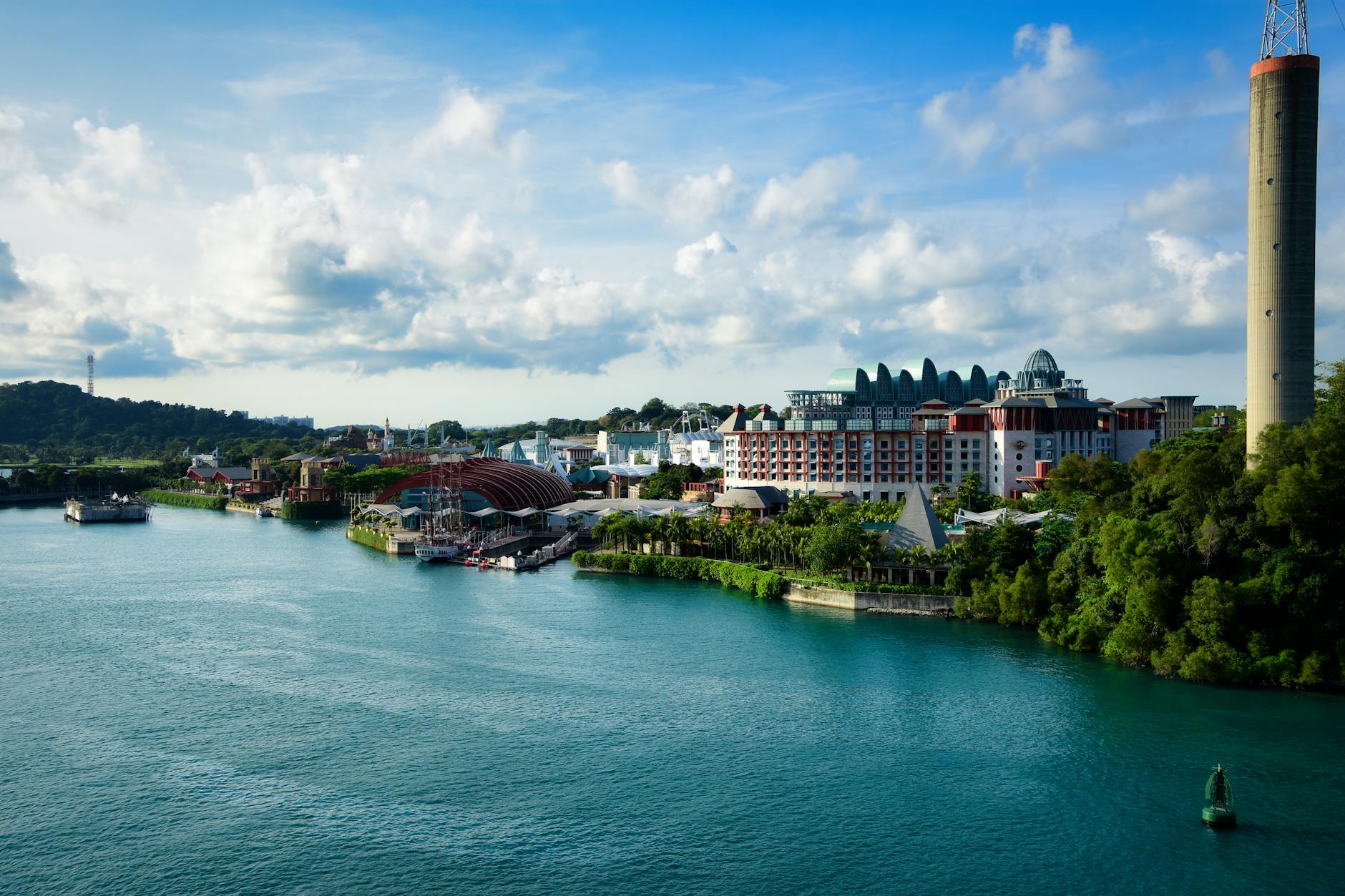
Sentosa is a resort island joined to the mainland by a causeway and the monorail from VivoCity mall. Universal Studios, the S.E.A. Aquarium, Adventure Cove waterpark and three man-made beaches sit within a few square kilometers, with free shuttle buses and a beach tram linking them. Getting on costs S$4 by the Sentosa Express monorail; walking across the Boardwalk from VivoCity is free and takes 15 minutes. Once on the island there is no reason to leave for a day or two, and the city center is 20 minutes away by MRT from HarbourFront when you do.
Island hotels are resort-style and priced accordingly, S$350 to S$700 for most, with villas above that. Amara Sanctuary Sentosa occupies restored colonial barracks on a hill above Palawan Beach, with pool villas and a lot of greenery between the rooms. Siloso Beach Resort is the budget end of the island, a simpler hotel with a landscaped pool a minute from Siloso Beach, usually under S$250. The usual pattern that works is two nights here with the theme parks, then the rest of the trip in town.
Pros and Cons of Sentosa

Pros:
- Universal Studios, the aquarium and the waterpark within walking or shuttle distance of every hotel.
- Beaches with calm, shallow water, good for children.
- Resort pools, spas and kids’ clubs that city hotels lack.
- City center 20 to 30 minutes away by monorail and MRT.
Cons:
- Resort prices for rooms, food and attractions; a Universal Studios ticket is about S$80.
- Nothing of the real city on the island; it is a theme park with beaches.
- Island entry fee, small but constant, on every arrival by monorail or car.
Who it suits: families with children under twelve, couples who want pool days between city days, and anyone whose trip is built around the theme parks.
Booking Tips That Apply Everywhere
Singapore hotel rates move with the calendar more than in most cities. The Formula 1 weekend in September, the Chinese New Year week in January or February, and the second half of December push prices up 50 to 100 percent across every district, and the good mid-range places sell out a month ahead. The quiet months are March to May and August, when the same rooms drop by a quarter or more.
Distance to an MRT station matters more than distance to the sights. Fares run S$1 to S$2.50 by distance, trains arrive every two to five minutes, and the network reaches every district in this guide. A hotel 300 meters from a station is a better base than one 1.5 km from Marina Bay with no station nearby. Hotel pages on Booking.com list the nearest station and the walking time, and the map filter for hotels in Singapore shows the MRT lines, which is the first thing I check before the price.
From Changi Airport the MRT reaches the city center in about 45 minutes for S$2, with one change at Tanah Merah; a taxi takes 25 minutes and costs S$30 to S$45 depending on time of day. Late arrivals after midnight add a 50 percent taxi surcharge, so a hotel near the East-West line saves money on the first night. Arriving overland from Kuala Lumpur by bus, the terminals are at Golden Mile near Kampong Glam or at Woodlands in the north.
A pool is worth paying for. Daytime temperatures sit at 31 to 33 degrees every month of the year, with humidity to match, and most sightseeing happens between 9 am and 1 pm before the afternoon heat and rain. Nearly every hotel above three stars has a pool; the budget chains in Geylang do not, which is part of why they are cheap.
Choosing Between Them
A short version of the whole guide. Two or three nights on a first visit with money to spend: Marina Bay. The same trip at a lower price with the sights still on foot: Civic District or Chinatown. A week of eating and walking on a normal budget: Chinatown, or Little India and Kampong Glam for a little less. Children and theme parks: two nights on Sentosa, then town. Every dollar counts: Geylang or Joo Chiat with an MRT pass.
Whatever the district, the arithmetic is similar. Room rates range from about S$90 in Geylang to S$1,000 at Raffles, while the train between them costs S$2 and takes 20 minutes. Pick the neighborhood for what is outside the door at breakfast and at 10 pm, and let the MRT handle the rest.


