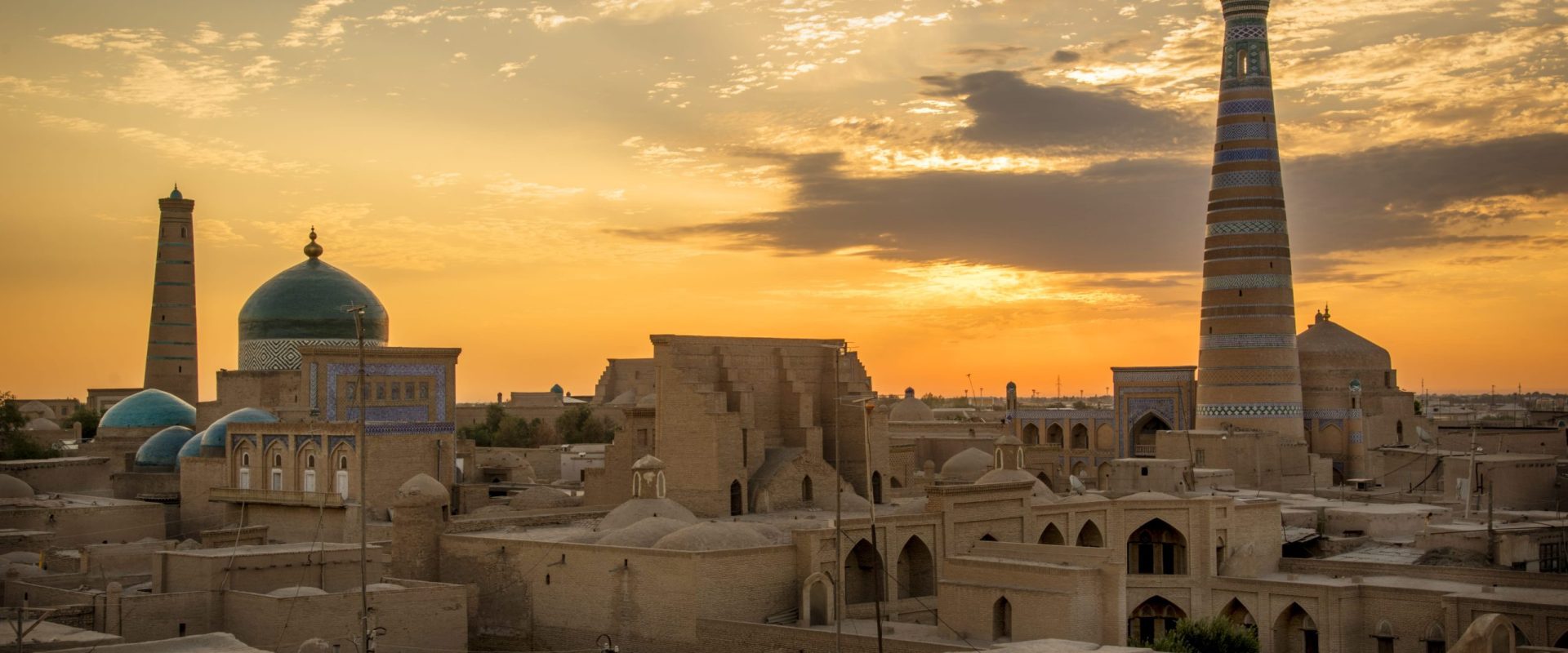
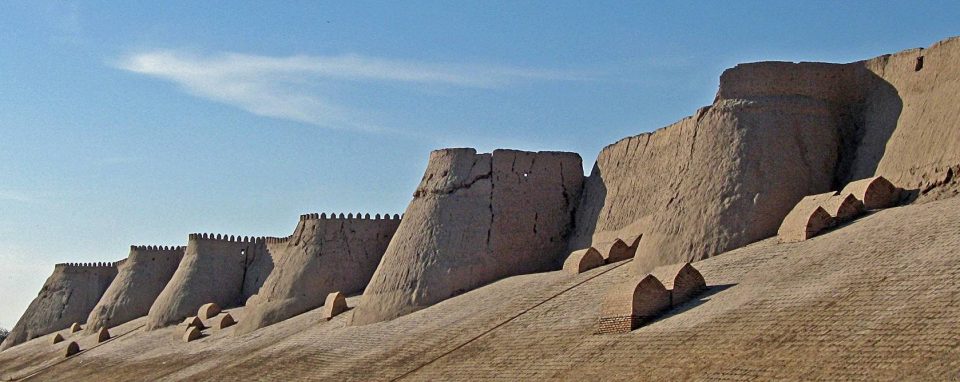
Khiva is the only city in Central Asia where the old town is still a complete walled city with people living inside it. Itchan Kala, the inner fortress, holds about 50 monuments and some 2,500 residents behind two kilometers of mud-brick wall. Almost everything you see was built between the 17th and early 20th centuries by the khans of Khiva. Older history, from the Khorezm kingdom and the mathematicians who worked here a thousand years ago, left less stone. It shaped everything that came after. I spent several months in Uzbekistan, and Khiva is the city where a little history changes the most about what you see. This is the history I wish I had read before the first visit. It is tied to the buildings you can enter, with 2026 prices in Uzbek sum.
Khorezm Before Khiva
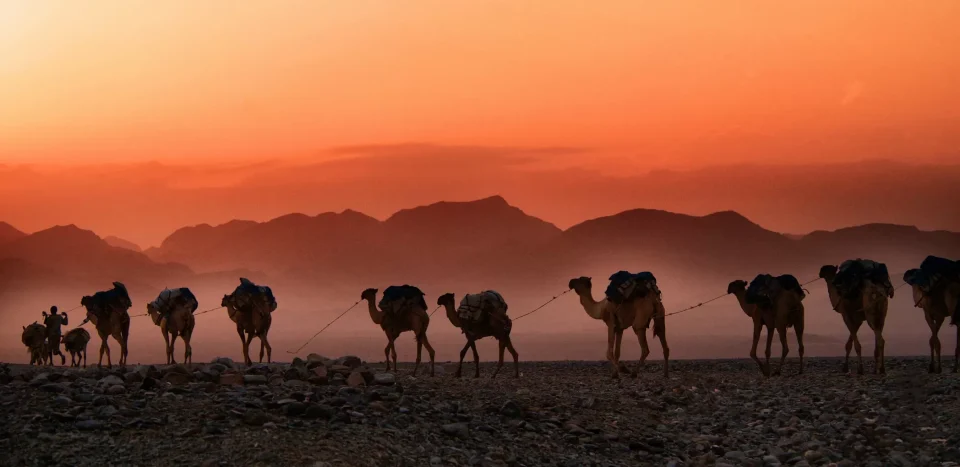
Khorezm is the name of the oasis around Khiva. It was a settled, irrigated kingdom by the 6th century BC, when it appears in Persian inscriptions as a satrapy of the Achaemenid empire. Its wealth came from the Amu Darya river and from position: caravans between China, Persia and the Volga crossed here. Arab geographers first mention Khiva in the 10th century as a small town on the caravan road from Merv. Legend goes further back and credits its founding to a well dug by Shem, son of Noah. A well marked as Kheivak, inside the walls near the Pahlavon Mahmud complex, is shown to visitors as that spring.
Khorezm’s intellectual peak came under the Mamun dynasty around 1000 AD. A court academy in the then-capital Gurganj drew Al-Biruni, who calculated the Earth’s radius to within 1 percent. Ibn Sina worked there for a time. Two centuries earlier the region had produced Al-Khwarizmi, born around 780 near Khiva, whose name gave us the word algorithm and whose book on calculation gave us algebra. A statue of him stands outside the west gate of Itchan Kala, and the Khorezm Ma’mun Academy has been revived in Khiva as a research institute.
Almost nothing from this period survives in Khiva. Genghis Khan’s Mongols destroyed Khorezm in 1220 and 1221. Timur finished the job in the 1380s. To see pre-Mongol Khorezm you go into the desert. Toprak Kala and Ayaz Kala, ruined fortresses 90 kilometers northeast, are covered in our guide to the Kyzylkum desert forts. One early monument does stand inside the walls, the Juma Mosque. It is early only in parts.
The Juma Mosque and Its 213 Columns
Khiva’s Friday mosque, in the center of Itchan Kala, is a flat-roofed hall with no dome, no courtyard and no portal. That design is closer to the pre-Islamic temples of the region than to anything in Samarkand. Its roof rests on 213 carved wooden columns, and this is where Khiva’s deep past hides. This building dates from 1788. Its columns were collected from earlier mosques and palaces, and at least 25 of them are from the 10th to 12th centuries, older than the Mongol invasion. Look for the ones with Kufic inscriptions and the deepest, most weathered carving; those are the oldest objects you will touch in Khiva.
Entry is included in the Itchan Kala combined ticket. Climbing the 47-meter minaret costs a separate 50,000 sum or so. From the top you get the best angle in the city on the Kalta Minor and the Kunya Ark together.
The Khanate and the Slave Market
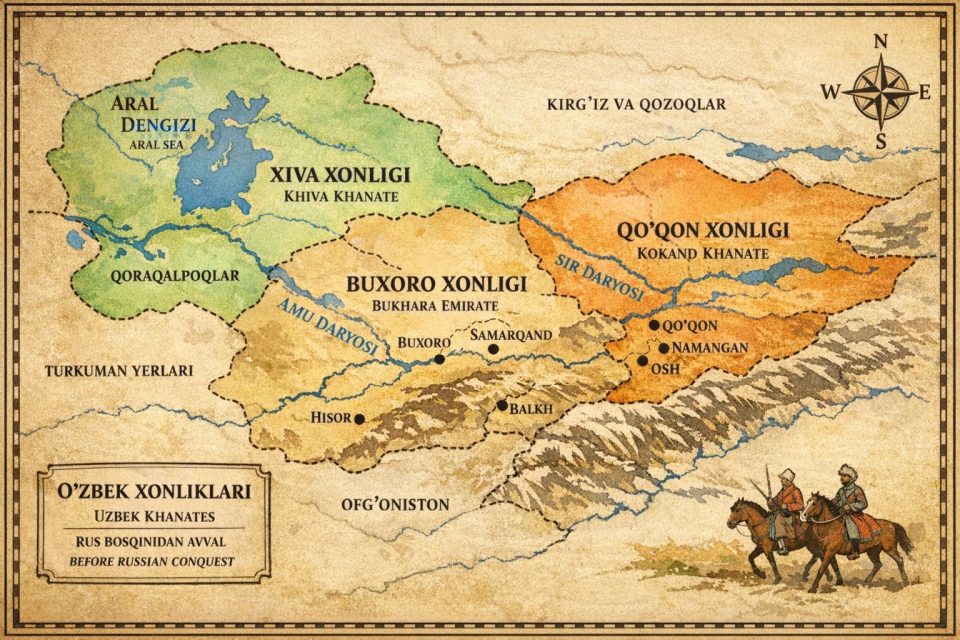
Khiva became a capital by accident. In the late 16th century the Amu Darya shifted course and left the old capital, Gurganj, without water. So the Uzbek khans of Khorezm moved their court to Khiva around 1598. From then until 1920 the Khiva Khanate ruled the oasis. It fought the Bukhara emirs to the east and the Turkmen tribes to the south. It also ran one of the largest slave markets in Asia. Persian and Russian captives taken by Turkmen raiders were sold in the square outside the east gate. Estimates for the 19th century run to tens of thousands of slaves in the khanate at any one time. Today that gate leads into a bazaar. The trade is silk and knives.
Kunya Ark, the old citadel in the northwest corner, was the khans’ first residence. It was begun in the 1680s and rebuilt over the next two centuries. Inside are a throne room with a painted wooden ceiling, a mint, a summer mosque tiled in blue and white, and a harem. Ak Sheikh Bobo, the bastion at the back, is the traditional sunset spot. Climbing it costs about 20,000 sum. Watch the light on the walls at 18:00 in spring or autumn and you will see why everyone is up there.
Across the city, the Tash Hauli palace built by Allakuli Khan between 1830 and 1838 is the khanate at its most confident. Its 163 rooms are arranged around three courtyards. Finest of the three is the harem court, with tiled walls in blue, white and green from floor to roof and carved columns on marble bases. Allakuli also built the madrasah and caravanserai next door that carry his name, paid for by the customs duties of a trade boom with Russia in the 1830s.
The Unfinished Minaret
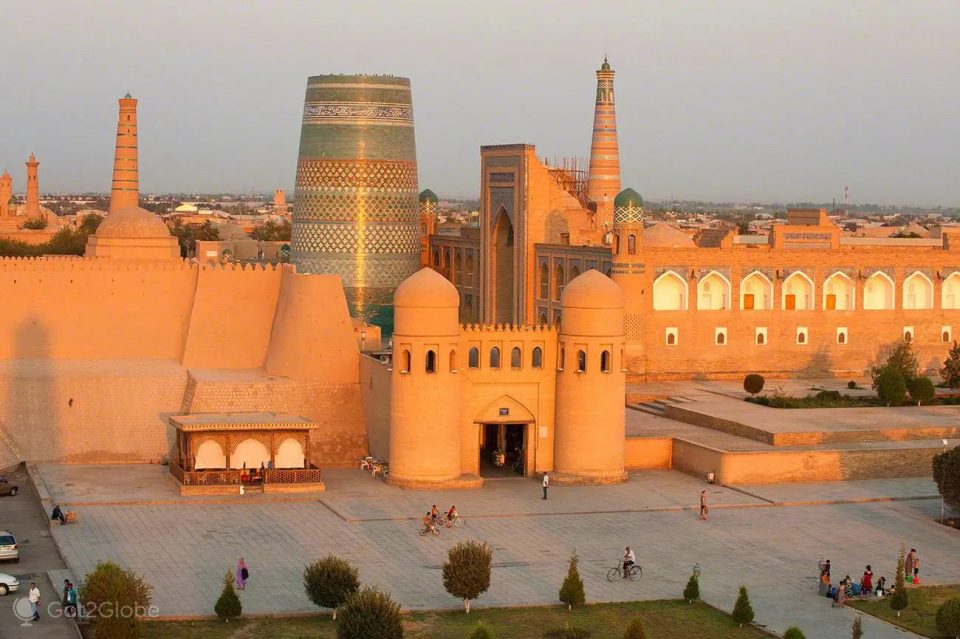
Beside the west gate stands a turquoise stump called the Kalta Minor. It is Khiva’s postcard because it was never completed. Muhammad Amin Khan started it in 1851 as part of a madrasah complex. By the account most guides repeat, he wanted it to reach 70 or 80 meters so he could see Bukhara from the top. He died in battle against the Turkmen in 1855 and work stopped at 29 meters. Its base is 14.5 meters across, wider than any minaret in Central Asia. Every inch of the surface is glazed tile. No other minaret of the period attempted that.
Next to it, the largest madrasah in Khiva, with 125 cells for 260 students, is now the Orient Star hotel. You can sleep in a student’s cell for about 60 to 80 US dollars a night with the minaret outside the window. It is one of the stranger places to stay in Uzbekistan, and it books out months ahead in spring and autumn. Our study of Uzbekistan hotel guest scores found Khiva’s hotels rated higher than any other city in the country, and this converted madrasah is one reason.
Russian Protectorate and the Last Khans
Russia had tried and failed to take Khiva twice, in 1717 and in the winter of 1839, when a 5,000-man column froze in the steppe and turned back. In 1873 General Kaufman came from three directions with 13,000 troops and the khan surrendered without a siege. Khiva kept its khan, lost its foreign policy and its slaves, who were freed by treaty, and became a Russian protectorate for 47 years. Trade with Russia then paid for the last great burst of building.
Islam Khoja was grand vizier to the reforming khan Isfandiyar. In 1910 he built the tallest structure in the city, a 57-meter minaret that tapers sharply and is banded in turquoise and white. A small madrasah beside it now houses the applied arts museum. He also opened Khiva’s first secular school, hospital and telegraph office, and was murdered in 1913, with the khan’s knowledge according to most accounts. Climbing his minaret costs about 50,000 sum and involves 118 steep steps in the dark. Outside the walls, the Nurullaboy palace was the khan’s attempt at a European residence. Finished in 1912, it has parquet floors from St. Petersburg and tiled stoves. It is the last building of the khanate.
It ended in February 1920. The Red Army took the city, the last khan Sayid Abdullah abdicated, and the Khorezm People’s Soviet Republic was declared in the Nurullaboy palace’s reception hall. In 1924 the republic was dissolved into the new Uzbek SSR. Soviet planners emptied much of Itchan Kala of residents in the 1970s to turn it into a museum city, then partially reversed the decision. UNESCO listed the walled town in 1990, the first site in Uzbekistan.
Tickets, Timing and the Order to See It
Entry to Itchan Kala itself is free at all hours, and the streets are at their best before 9:00 and after 18:00 when the tour groups have gone. A combined ticket sold at the west gate covers the monuments. It costs about 200,000 sum, roughly 16 US dollars, and is valid for two days. It includes the Kunya Ark, Tash Hauli, the Juma Mosque, the Pahlavon Mahmud mausoleum and a dozen smaller museums. Minaret climbs and the Ak Sheikh Bobo bastion are extra, 20,000 to 50,000 sum each. Photography is included. A guide licensed by the city costs 25 to 35 US dollars for a half day. Hire one. The buildings here do not explain themselves.
To follow the history in order, start at the Juma Mosque for the old columns. Move on to the Kunya Ark for the early khanate, then the east gate and Tash Hauli for the 1830s. Kalta Minor and the Muhammad Amin Khan madrasah cover the 1850s. Finish with Islam Khoja’s minaret and the Nurullaboy palace for the protectorate years. That is a full day at a slow pace. Getting here from Urgench airport or by train from Bukhara is covered in our guide to getting to Khiva. Food, crafts and where to stay are in the Khiva travel guide. A walking tour of Itchan Kala with a local historian follows the same chronology in about three hours.


