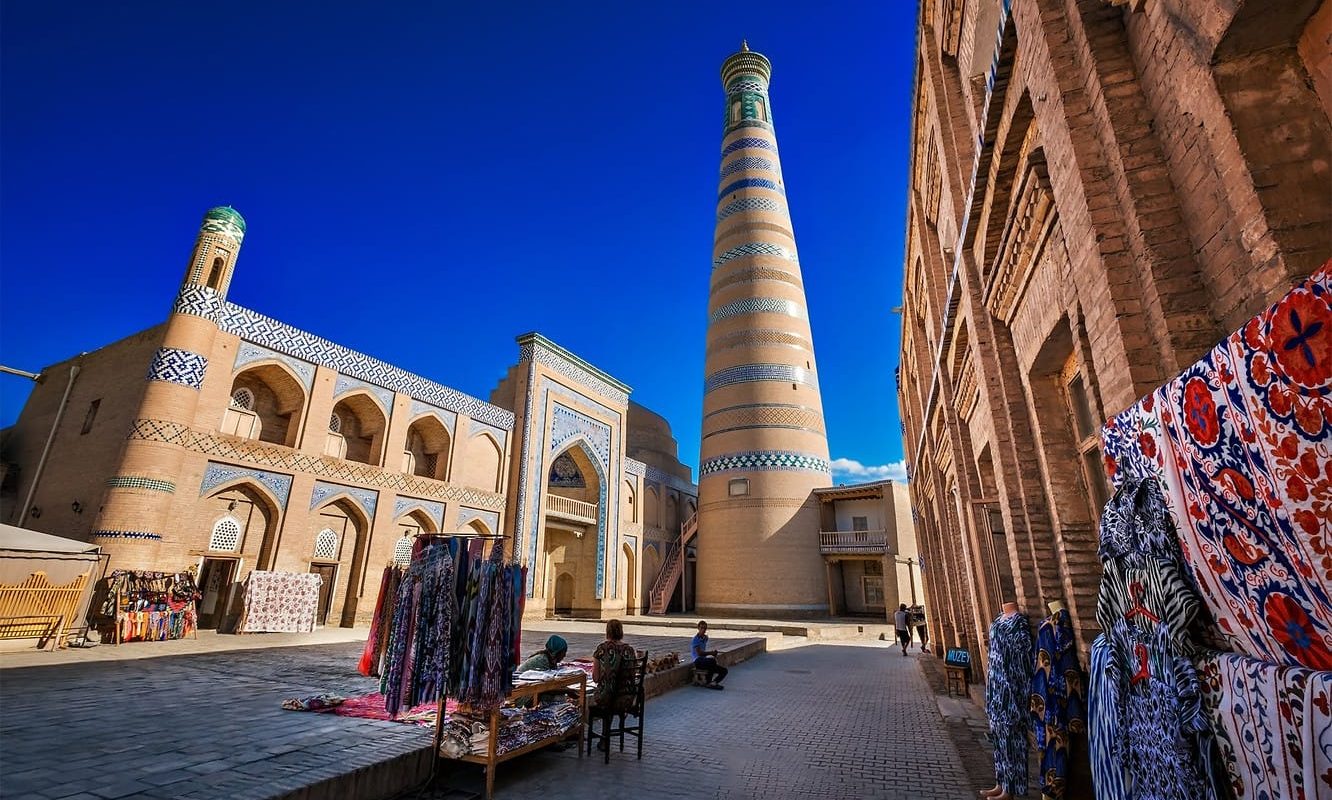
Khiva is the smallest of Uzbekistan’s three Silk Road cities and the only one where the old town survives whole, inside its walls. Everything a first-time visitor comes for sits within Ichan-Qala, a rectangle about 650 by 400 metres. You can cross it on foot in ten minutes, and one full day is enough for the four monuments below, with time left for the rooftops at sunset. In Uzbekistan I prefer to arrive by overnight train from Tashkent or Bukhara; the station is a short taxi ride from the North Gate.
Inside Ichan-Qala, the Soul of Khiva
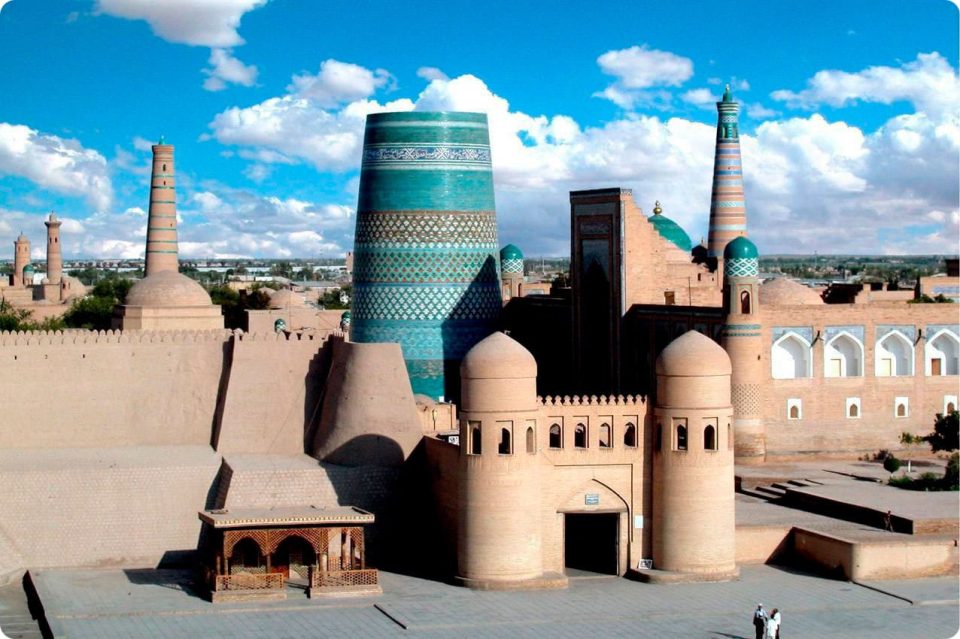
Ichan-Qala means “inner fortress”. Its walls are clay and straw, about 10 metres high and 2 km around, with four gates facing the compass points. The whole district was the first site in Central Asia on the UNESCO World Heritage list, back in 1990. Walking the district is free. A combined ticket, sold at the West Gate, covers most of the museums and monuments inside and is valid for two days; expect to pay roughly the price of a dinner for two, and keep the ticket, because staff check it at every door. If you want the history in order rather than piecemeal, a guided walk along the fortress walls and through the main lane takes about three hours.
Inside, monuments stand shoulder to shoulder: madrasahs, mosques, minarets and two palaces. Start with Kunya-Ark, the old citadel by the West Gate. It was the khans’ residence from the 17th century, and the summer mosque inside is lined floor to ceiling with blue and white majolica. Pay the small extra fee for the Ak-Sheikh Bobo watchtower on top of the citadel. It is the best vantage point in Khiva, and at sunset the mud walls turn orange against the minarets.
Next door is the Muhammad Amin Khan Madrasah, the largest in the city, built in the 1850s. It trained scholars, judges and clergy for the Khanate; today it operates as a hotel, so you can walk into the courtyard even without a ticket.
The main lane between the West and East gates doubles as the bazaar. Workshops sell carpets, suzani embroidery, ceramics and carved wooden stands for the Quran. Prices are set for tourists; bargaining takes a third off without effort. The best woodcarvers work in the small courtyards off the main lane, and most will let you watch.
Much of Khiva’s story is concentrated in this one square kilometre, from the slave market by the East Gate to the Soviet-era restoration that gave the town its current tidy look. A guided walk through Ichan-Qala is worth it mainly for that layer: the buildings explain themselves, the politics behind them do not.
The Unfinished Kalta Minor Minaret
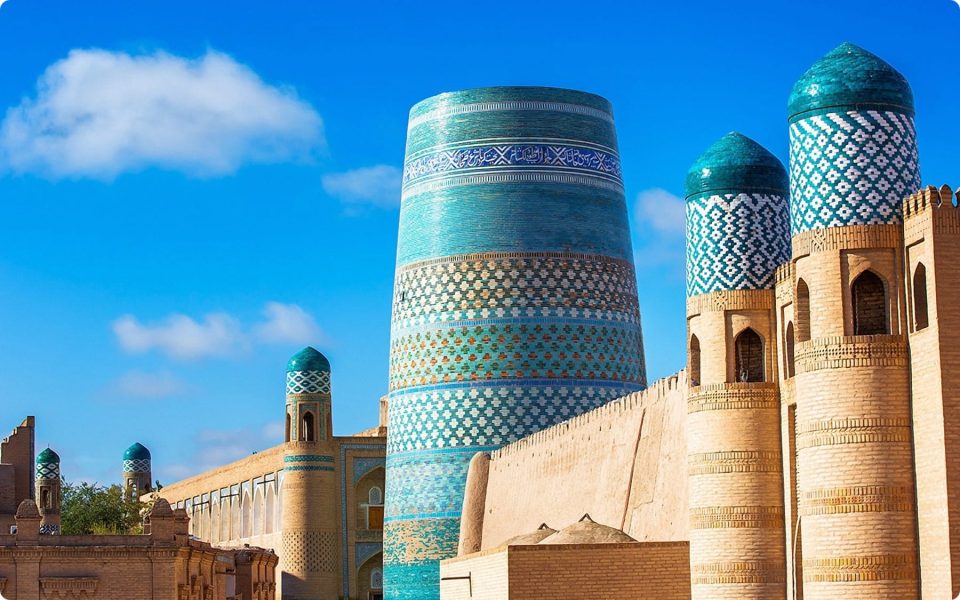
Kalta Minor stands right at the West Gate, so it is the first thing you see. “Kalta” means “short”. Muhammad Amin Khan started it in 1851 and planned a tower tall enough to see Bukhara from the top, around 70 metres. He was killed in battle in 1855 and the work stopped at 29 metres. What was left is a fat turquoise cylinder, 14.5 metres across at the base, unlike any other minaret in Central Asia.
Minarets in Khorezm were never only for the call to prayer. A finished tower would have doubled as a lookout over the flat Khorezm oasis, where caravans crossing the Kyzylkum could be seen hours before they arrived.
The surface is the point. Bands of glazed majolica in turquoise, blue, white and green run around the whole tower, with geometric and floral patterns and a strip of Kufic script. Morning light from the east brings out the blues; by late afternoon the gate side is in shadow, so photograph it before noon.
A narrow staircase spirals up inside. It is closed to visitors, and there is no viewing platform at the top anyway. For a view, use the Kunya-Ark watchtower or the Islam Khoja minaret further east, which is open for a small fee.
Kalta Minor has become the symbol of Khiva on every poster and banknote illustration. It also makes a useful landmark: from almost any rooftop cafe inside the walls you can see it, so getting lost in the lanes is never a real problem.
Quiet Hours at the Pahlavan Mahmud Mausoleum
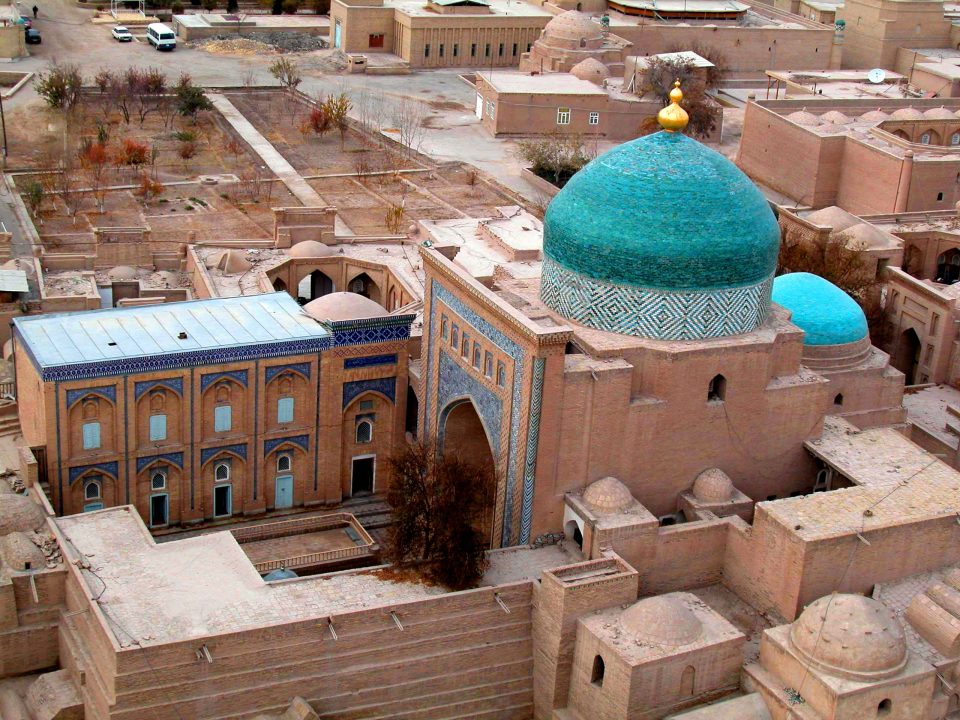
The Pahlavan Mahmud Mausoleum, under the biggest turquoise dome in Ichan-Qala, is the main pilgrimage site in Khiva. Pahlavan Mahmud lived in the late 13th and early 14th century. He was a furrier by trade, a wrestler who, according to the stories, never lost a bout, and a Sufi poet who wrote in Persian. Khorezm adopted him as its patron saint.
Local families still come here to pray for children and health, and you will see women tying ribbons and men reading quietly in the corners. Visit early, before the tour groups, or in the last hour before closing. Shoulders and knees covered, shoes off at the door of the inner hall.
The current building dates from 1810 to 1835, when the Khiva khans turned a modest tomb into a dynastic burial ground. Inside, every surface of the main hall is covered in glazed tiles, blue and white with touches of green, in a density you will not see anywhere else in the city. The marble tombstone carries lines from Pahlavan Mahmud’s own verses.
The complex includes a small mosque and a madrasah, both still in use, and the tombs of several 19th-century khans, including Muhammad Rahim Khan II. A courtyard well in front of the entrance is believed to give healing water; expect a short queue.
Allow 30 to 40 minutes. The mausoleum is included in the combined Ichan-Qala ticket, and photography inside is allowed without flash.
Inside the Tosh-Hovli Palace
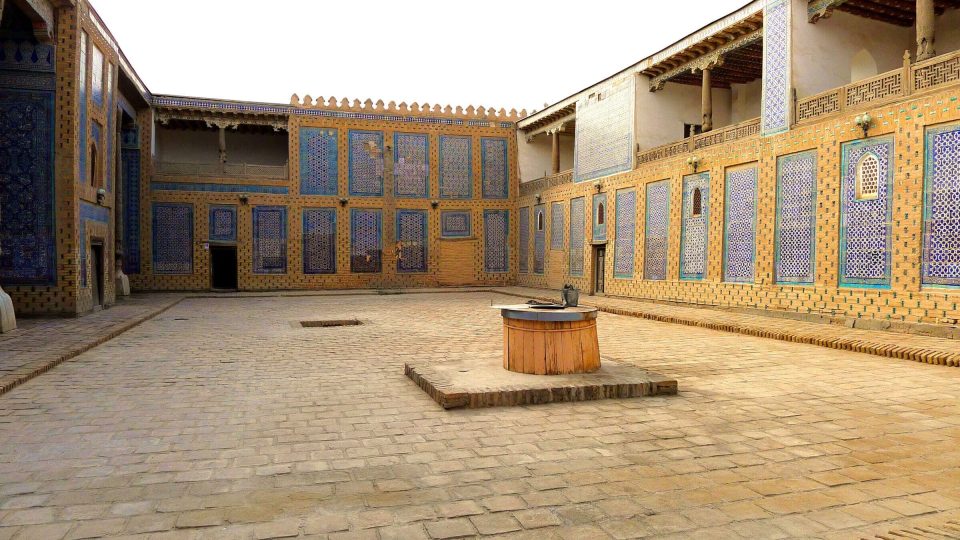
Tosh-Hovli, “the stone house”, is in the eastern half of Ichan-Qala, near the East Gate. Allakuli Khan built it between 1830 and 1838 as a replacement for Kunya-Ark, and the two palaces make a useful pair: Kunya-Ark is the fortress, Tosh-Hovli is the showpiece. Most tours of the old center of Khiva finish here because it is the last big monument on the way to the gate.
The palace has 163 rooms around three courtyards. The harem courtyard is the one everybody photographs: five iwans, open-fronted rooms, each with a carved wooden column on a stone base and walls tiled in dark blue and white. The ceilings are painted in red and gold, which was Khiva’s signature combination.
The two other courtyards were for official business: the Ishrat-Hovli for receptions, with a raised platform for the khan’s yurt, and the Arz-Hovli for court hearings. They are connected by narrow corridors, and the harem section has a separate entrance, so if a door is locked, walk around the outside to the next one. Tosh-Hovli is on the combined ticket. Give it 45 minutes, and go in the morning when the sun reaches the tiled walls of the harem court.
Where to sleep is a separate question: our Uzbekistan hotel score study put Khiva’s guesthouses at the top of the country, and several of them sit inside the walls, a few steps from Kalta Minor.


