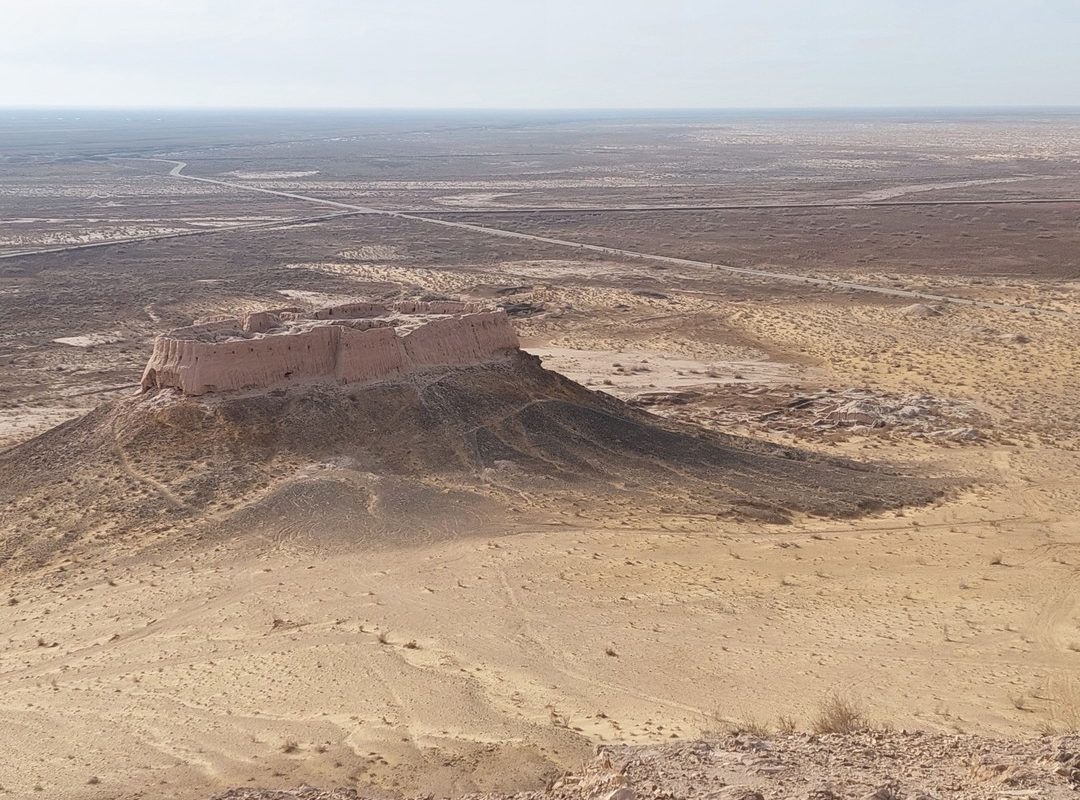
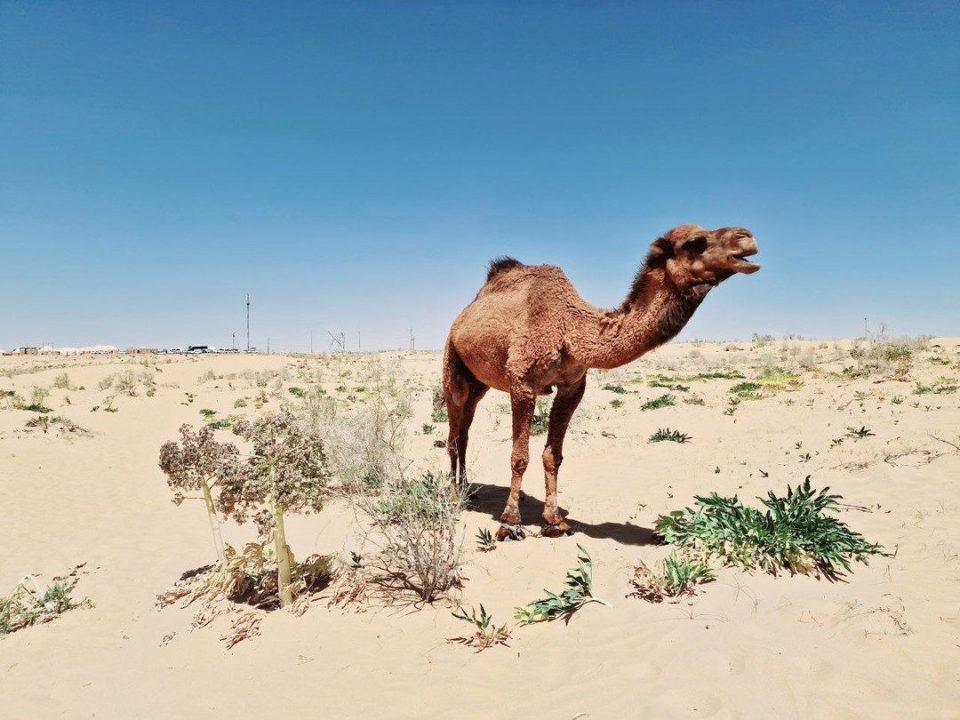
Kyzylkum means “red sand,” and from the Khiva road that is all you see: low dunes, saxaul bushes, the occasional camel. Then a clay wall rises out of the flatness, thirty meters high and two thousand years old, with nobody around but a yurt camp at its foot. Along the right bank of the Amu Darya, in the Ellikkala district of Karakalpakstan, there are around fifty of these ruined fortresses, and a dozen can be visited in a single day from Khiva.
Why There Are Fortresses in the Desert
Two thousand years ago this was not desert. Khorezm, the oasis state on the lower Amu Darya, ran irrigation canals far out into what is now sand, and the forts guarded fields, canal heads and the caravan tracks toward Bukhara and the Silk Road. When the river shifted its course and the canals silted up, the towns were abandoned and the sand moved back in. Dry air did the rest: mud brick that would have dissolved in a wetter climate has stood here since the 4th century BC.
How the Forts Were Built
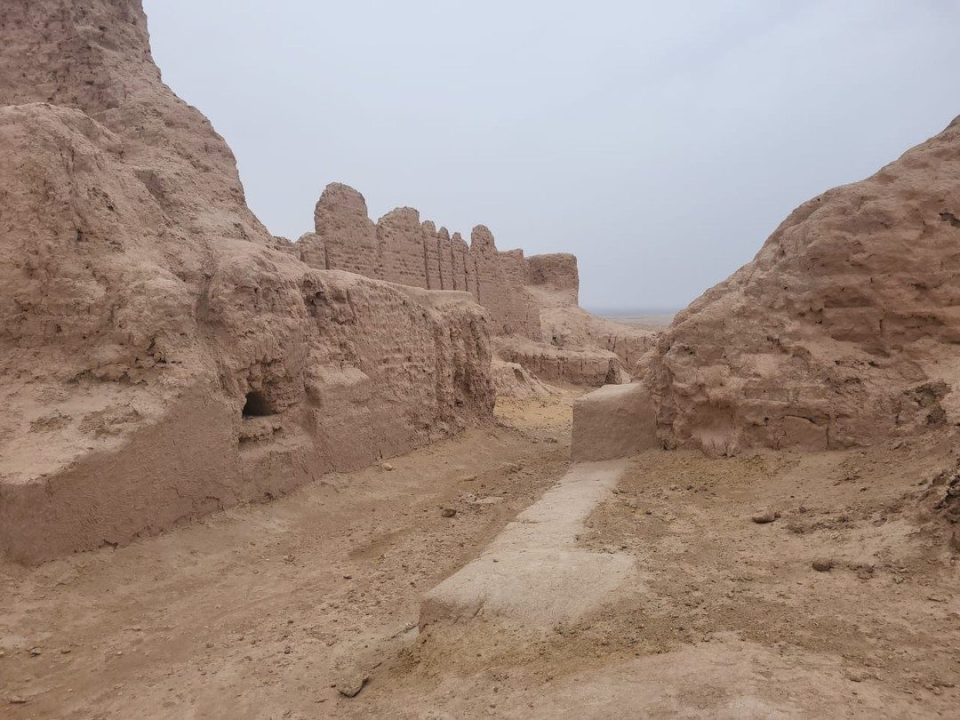
Builders used what the oasis gave them: river clay mixed with straw, pressed into large square bricks and dried in the sun, then laid on a platform of rammed earth. Walls were double, with a vaulted corridor inside for archers, and the loopholes were cut at an angle so a defender could shoot down at attackers under the wall. Corners were rounded or reinforced with towers. None of it needed stone or timber, both of which were rare here.
Toprak-kala is the one to see first. Built in the 1st century AD, it was the capital of Khorezm for about two centuries, a rectangle of 500 by 350 meters with a three-towered palace rising 25 meters above the town. Soviet archaeologists under Sergey Tolstov dug here from 1938 and found painted halls, clay statues of kings larger than life, and an archive of documents on leather and wood, the oldest written Khorezmian known. Most of that is now in museums in Nukus and Tashkent, but the palace mound and the wall line are still clear, and a Toprak-kala visit is included in almost every desert-castles tour from Khiva.
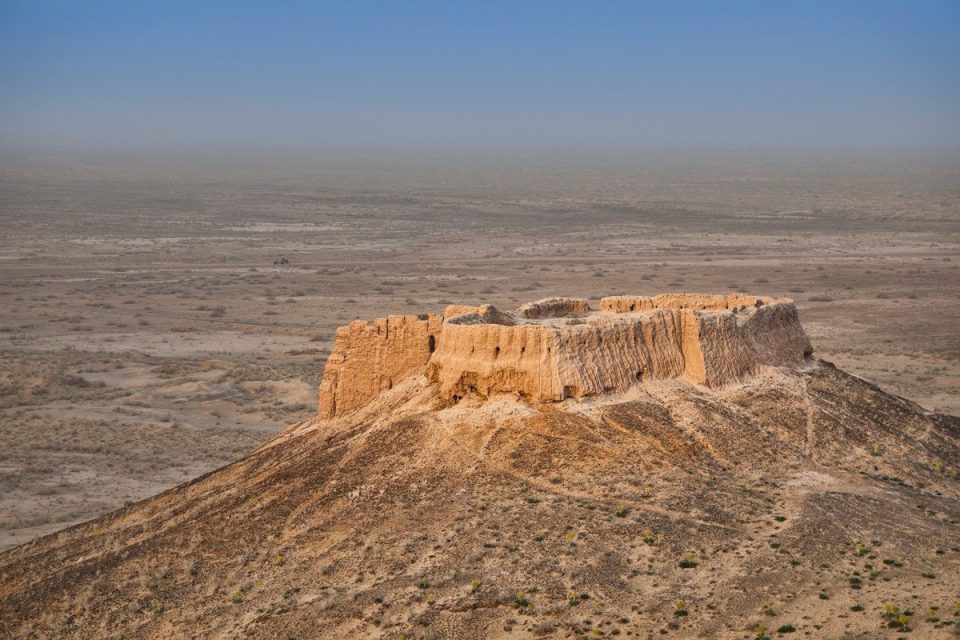
Ayaz-kala, 20 kilometers further east, is three forts on and around one hill. Ayaz-kala 1 on the summit dates from the 4th to 3rd centuries BC and is the largest, with walls still ten meters high and a view over a salt lake and the whole oasis edge. Ayaz-kala 2, a smaller oval fort from the 6th or 7th century AD, sits on a lower cone and once held a feudal lord’s residence. Ayaz-kala 3 below was the garrison town. A yurt camp at the base serves lunch and lets you stay the night, and climbing Ayaz-kala at sunset is the moment most people remember from the whole trip.
Other Forts Worth the Detour
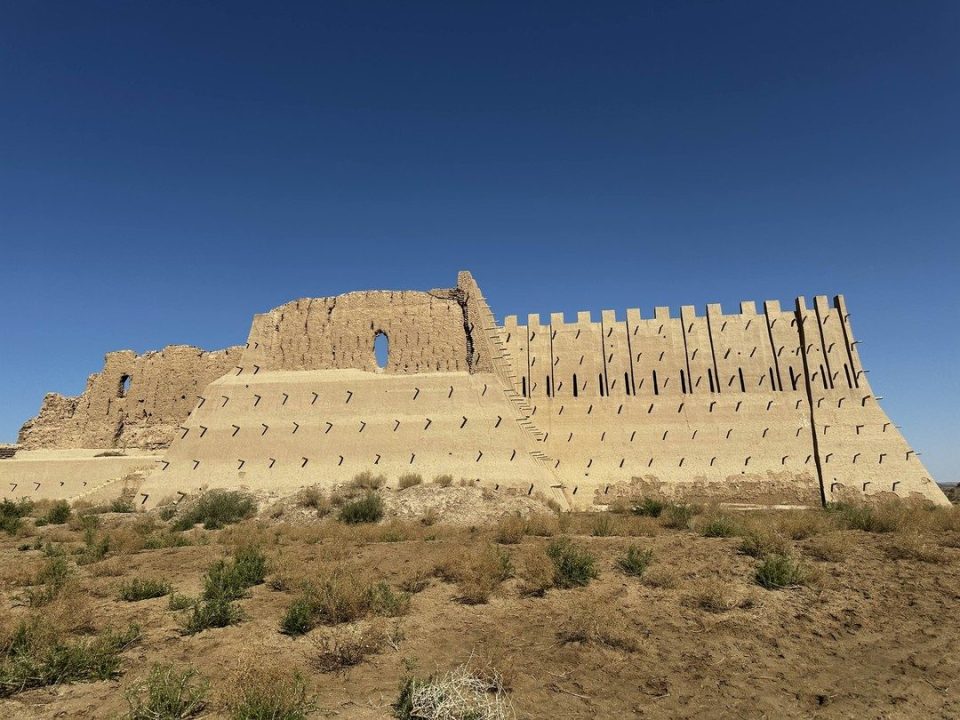
Kyzyl-kala, a few kilometers from Toprak-kala, is the odd one out: a compact square fort from the 1st century AD that was heavily rebuilt in the 2010s, so its walls stand complete with battlements. Purists dislike the restoration, but it shows what the others looked like when new. Koy-Krylgan-kala, south of the main road, is a round building 90 meters across from the 4th century BC, part temple, part observatory, with a ring of rooms around a central tower. Guldursun-kala near the town of Beruniy is the biggest of all, with 15-meter walls enclosing almost 8 hectares, and it was still in use when the Mongols came in 1221.
On the way from Nukus or Urgench, Chilpyk is worth a stop even if forts are not your thing. It is a Zoroastrian tower of silence from around the 2nd century BC, a hollow clay ring on a conical hill beside the Amu Darya, where bodies were left for the birds before the bones went into ossuaries. From the top you see the river, the cotton fields and the start of the desert in one sweep.
What Archaeologists Found
Almost everything known about ancient Khorezm comes from the Khorezm Archaeological and Ethnographic Expedition, which worked here from 1937 until the 1990s and used aerial photography to map canal systems invisible from the ground. Finds from the forts include terracotta figurines of a fertility goddess, coins of Khorezmian kings, ceramic ossuaries with painted faces, and wall paintings in mineral pigments that kept their color under the sand.
Very little of it stays on site. There are no fences, no ticket booths and no signs at most forts, which is part of the appeal and part of the problem. Serious pieces are in the Savitsky Museum in Nukus, which deserves half a day of its own, and in the State Museum of History in Tashkent. At the forts themselves you walk on pottery shards; taking them is illegal and, given how many there are, pointless.
Legends the Drivers Tell
Every driver on this route has a story, and most involve Alexander the Great, who did reach the Amu Darya in 329 BC, or Genghis Khan, whose army destroyed Khorezm’s cities in 1220 and 1221. Buried treasure comes up a lot. One fort near Toprak-kala is called Kyrk-kyz-kala, “fortress of forty girls,” and the legend attached to it tells of forty young women who held the walls against a siege and jumped to their deaths rather than surrender. Versions of the same tale exist across Central Asia, and the name turns up near Termez too, which says something about how the story travelled with the people.
Local people also say the name Ayaz-kala comes from a slave called Ayaz who won his freedom by building the fort. Historians have no record of him. Nobody at the yurt camp minds.
Getting There from Khiva
Most visitors base themselves in Khiva hotels inside or just outside the old city walls and treat the forts as a day out. Toprak-kala and Ayaz-kala are about 90 and 110 kilometers from Khiva by road, roughly two hours each way with a stop at the Amu Darya bridge. A private taxi for the day costs 50 to 80 USD depending on your bargaining and how many forts you add; the standard loop is Chilpyk, Toprak-kala, Kyzyl-kala and Ayaz-kala with lunch at the yurt camp. A guided desert fortresses day trip costs more but comes with someone who can explain what you are standing on, which at an unsigned mud wall makes a difference.
Go between April and early June or from September to October. In July the ground at Ayaz-kala reaches 45°C and there is no shade on the climb. Bring two liters of water per person, a hat, closed shoes for the loose brick, and cash in sum for the yurt camp, where a lunch of plov, salad and tea runs about 8 to 10 USD and a night in a shared yurt with dinner and breakfast around 30 USD. Mobile signal fades after Beruniy, so download maps in advance.
Uzbekistan has been restoring some forts and leaving others alone, and for now there is no entrance fee anywhere except a small charge at Kyzyl-kala. When I lived in Uzbekistan, this loop was the thing I sent every visiting friend to do after Khiva itself: the same price as a taxi to the airport, and a wall that has stood since before Rome had emperors.


