Bangkok is one of the few big capitals where a careful traveller can live well on $30 a day. Street food costs less than a coffee in Europe, the Skytrain fare tops out at 62 baht, and a clean hostel bed near the river goes for the price of a London bus ticket. The expensive version of Bangkok exists too, in rooftop bars and private longtail boats. This guide covers the cheap version: where to sleep, which sights are worth the ticket, how to move around for pennies, and the mistakes that quietly double a budget.
Affordable Hotels with Great Reviews
Bangkok has more hostels per square kilometre than almost any city in Asia, and competition keeps the quality up. For 500-800 baht ($14-23) a night you get air conditioning, a locker, decent Wi-Fi and often a pool. Three well-reviewed options in the Old Town, all within walking distance of the Grand Palace, give an idea of what that money buys. Searching Bangkok hostels by guest score rather than price turns up dozens more in the same bracket.
Nitan Hostel Khaosan
- Location: Khaosan area
- Price: from 500 THB per night
- Description: A small hostel in the middle of the backpacker district, with clean rooms, free Wi-Fi and staff who will draw a bus route on a napkin for you. Light sleepers should ask for a room away from the street: Khaosan Road runs until 2 am.
Here Hostel
- Location: Old Town, near Wat Suthat
- Price: from 600 THB per night
- Description: A converted shophouse with a modern interior, free breakfast and a small pool, which is rare at this price. Ten minutes on foot to the Golden Mount and twenty to the Grand Palace.
The Printing House Poshtel
- Location: near Democracy Monument
- Price: from 800 THB per night
- Description: A design hostel in a former print shop with a cafe downstairs and a rooftop bar. Private rooms here cost about what a dorm bed costs in Singapore, and the reviews are consistently among the best in the Old Town.
Budget-Friendly Tours and Excursions
Most of what people come to Bangkok to see costs nothing or close to it. Temples charge 100-300 baht, markets are free, and the river is a public road. Organised tours make sense in exactly two cases: when a place is hard to reach on your own, like the floating markets outside the city, and when you want context that a sign in Thai will not give you.
Free Walking Tours
Several companies run tip-based walking tours of the Old Town and Chinatown, usually starting in the morning near the Giant Swing or at Hua Lamphong station. You pay what you think the two or three hours were worth, and 200-300 baht per person is normal. Guides are mostly students or young locals, and the route covers the main sights plus the alleys you would never find alone.
DIY Itineraries
Planning your own day is the single biggest saving in Bangkok, because the main sights sit close together along the river. A sample day that costs under 1,000 baht in tickets looks like this:
- Grand Palace and Temple of the Emerald Buddha (Wat Phra Kaew)
- Entrance fee: 500 THB.
- Time to visit: 2-3 hours. Go at 8:30 when the gates open; by 10 the tour groups arrive. A guided tour of the Grand Palace is the one place where a guide earns the fee, since nothing inside is labelled in detail.
- Temple of the Reclining Buddha (Wat Pho)
- Entrance fee: around 300 THB.
- Time to visit: 1-2 hours. The traditional massage school inside charges less than half what hotel spas ask.
- Temple of Dawn (Wat Arun)
- Entrance fee: around 200 THB. The cross-river ferry from Tha Tien pier costs 5 THB.
- Plan for 1-2 hours here, ideally late afternoon for the light on the porcelain tiles.
- Lunch at a street food stall
- Cost: 50 to 150 THB per dish. Pad krapao with a fried egg runs 60-70 THB almost anywhere outside the tourist strips.
- Stroll through Chatuchak Market
- Entry: free. Weekends only, from about 9 am to 6 pm.
- Budget 2-3 hours for a proper wander. Take the MRT to Kamphaeng Phet station, which opens straight into the market.
Using Public Transport
Public transport in Bangkok is cheap and, away from rush hour, quick. BTS Skytrain fares run 17-62 THB, MRT subway fares 17-45 THB, and a Rabbit card saves fiddling with coins at the BTS machines. Orange-flag express boats on the Chao Phraya cost 16 THB flat and connect Sathorn pier with the Grand Palace and Khaosan in 20-30 minutes, which beats any taxi in traffic. Ordinary buses charge 8-25 THB; the non-air-conditioned red ones are the cheapest and the slowest. Taxis start at 35 THB on the meter, and the only trick is to insist on the meter. Grab tends to cost a little more than a metered cab but removes the negotiation.
Budget-Friendly Sightseeing Routes
Beyond the palace and the three big temples, Bangkok rewards walking. Our longer guide to Bangkok’s main sights lays out full routes by district; below are the pieces that cost the least.
Markets and Street Food
Markets are where Bangkok eats, shops and spends its evenings, and all of them are free to enter. Three worth building a day or an evening around:
- Chatuchak Market: Bangkok’s biggest market, open Saturdays and Sundays, with roughly 15,000 stalls selling clothes, ceramics, plants and lunch. Arrive before 10 am for cooler air and emptier lanes.
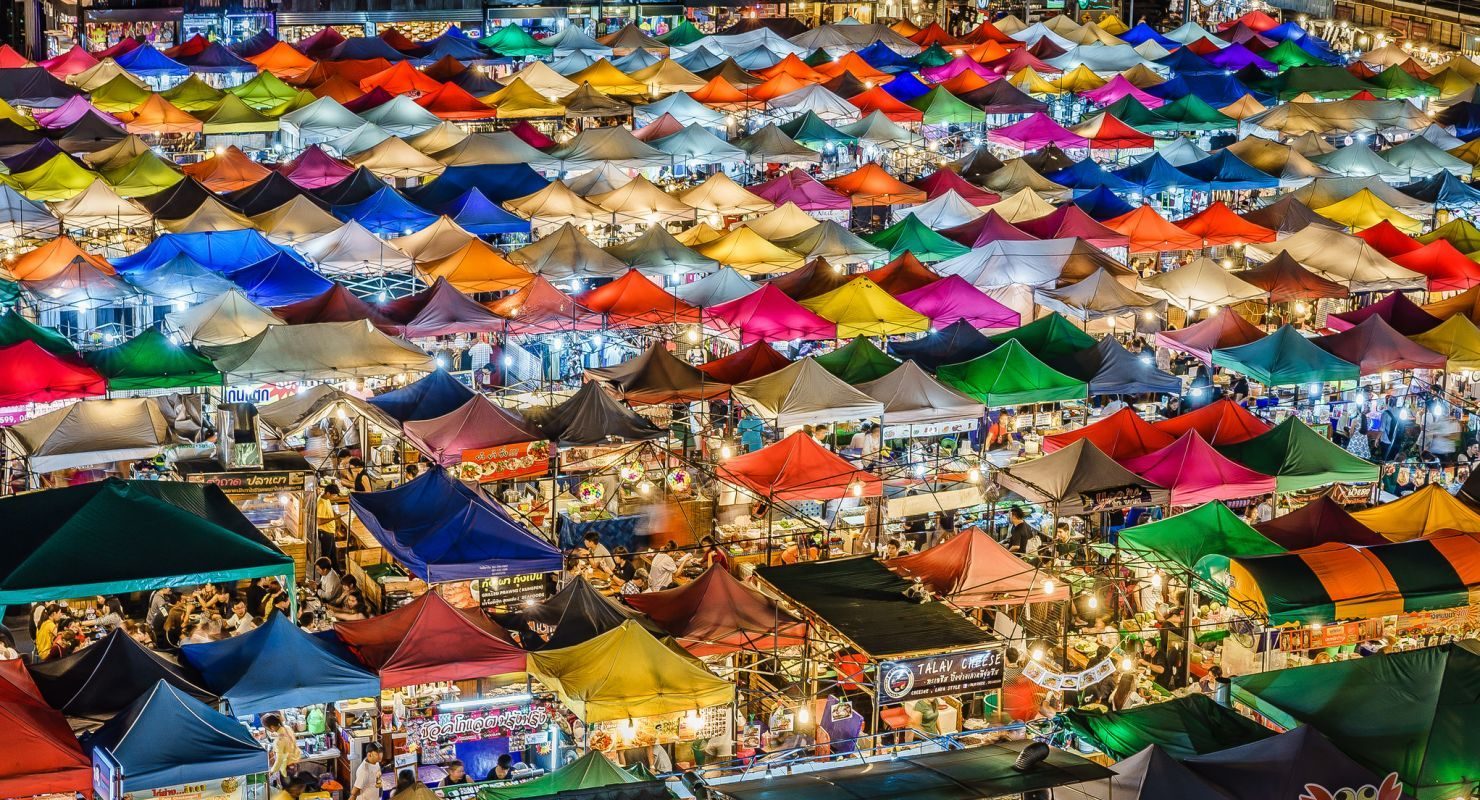
- Train Night Market Ratchada: An evening market next to Thailand Cultural Centre MRT station with cheap seafood, grilled skewers and secondhand stalls. A guided evening at the Train Night Market helps if you want someone to order for you, though pointing works fine too.
- Floating markets: Damnoen Saduak and Amphawa are 80-90 km outside the city, and public transport there takes half a day each way. This is the one outing where a floating market tour with transport included usually costs less than doing it alone. Amphawa runs Friday to Sunday afternoons and is the less touristy of the two.
Parks and Green Spaces
Bangkok’s parks are free, open from about 4:30 am, and at their best early, when locals run, do tai chi and feed the monitor lizards:
- Lumpini Park: 58 hectares in the middle of the business district, with a lake, pedal boats for 40 THB per half hour and a free outdoor gym. The monitor lizards are harmless and used to cameras.
- Benjakitti Park: Newer and larger, with a raised walkway through a wetland forest and a bike lane around the lake. Bike rental at the entrance costs a few dozen baht an hour.
Cultural and Historical Sights
Outside the Grand Palace, most temples charge a nominal fee or nothing at all. A half-day temple tour covers several of them with transport, but two in particular are easy to reach on foot from the Old Town hostels:
- Wat Saket (The Golden Mount): About 100 THB to climb the 300-odd steps to the gilded chedi. The view takes in the whole Old Town, and the bells along the stairway are there to be rung.
- Jim Thompson House: A teak house-museum built by the American who revived Thai silk after the war. The ticket is around 200 THB and includes a guided walk through the house, which is the only way to see it.
Bangkok also works as a base for a cheap seaside break. A bus from Ekkamai station to Pattaya costs about 130 THB and takes around two hours, and our guide to Pattaya covers where to stay and what a day there costs.
More Tips for Saving Money
Using Booking Apps and Websites
Hotel prices in Bangkok move a lot between platforms. Agoda, which is Thai-owned, often lists local guesthouses that Booking.com does not, and the reverse is true for international chains. Checking both takes two minutes and regularly saves 10-20 percent. Member rates and the discount coupons that appear in the apps on weekdays are worth a look before paying the headline price.
Seasonal Discounts and Promotions
Low season runs from May to October. Rain usually comes as a one-hour downpour in the late afternoon, not as a week of drizzle, and hotel rates drop by a third or more. In my experience the city is at its most pleasant in the first weeks of the rains, when the dust is gone and the heat eases after dark. Avoid the days around Chinese New Year, when hotels fill with visitors from across the region and prices jump.
Free Events and Festivals
Bangkok’s biggest festivals are street events, and watching costs nothing. Songkran, the Thai New Year on 13-15 April, turns Khaosan and Silom roads into a three-day water fight. Loy Krathong in November fills the river and park lakes with candle-lit floats, and Lumpini Park is the easiest place to join in. Chinatown’s Vegetarian Festival in October is nine days of yellow-flag food stalls along Yaowarat Road, with dishes at 30-50 THB.
Put together, a frugal day in Bangkok costs around 1,000-1,500 THB ($28-42): a hostel bed, three street meals, a few transit fares and one paid temple. Flights are the only line that scales with the season, so it pays to watch fares to Bangkok for a month and book when they dip. Once you land, the city does the saving for you.
Cheap rooms in the capital are a mixed bag, and we measured just how mixed in our study of hotel guest scores across Thailand.


